Are inflatable paddle boards worth it? The honest version
Yes for most people, and genuinely no for three kinds of buyer. Here is how to tell which one you are before you spend anything.
By Scooter M. · Published September 12, 2026 · Last updated September 12, 2026
DisclosureSome links on this page are Amazon Associates links. If you buy through one we earn a commission at no extra cost to you. It does not change what we recommend or the order we recommend it in -- here is how we rank, and here is how the site is funded.
"Are inflatable paddle boards worth it" is really three questions wearing one coat: are they any good, will they last, and will I actually use one. The first two are answerable from published specifications. The third is about you, and it is the one that decides most of these purchases.
This page answers all three without pretending the answer is always yes. There are three kinds of buyer we would actively tell to skip an inflatable, and they are named below before any product is.
The short version
At 15 psi a drop-stitch board is a rigid panel, not a soft tube. That is why the category works at all.
Every inflatable paddle board in our registry is a single air chamber -- no redundancy, unlike a three-chamber kayak.
Two of eight brands publish a warranty term. Five years on the Bluefin Cruise 10'8, three on the NIXY Newport G5, nothing from the other six.
Pumping is part of the purchase: 128 to 192 strokes by hand on the boards whose volume is published.
Nobody in our registry sells a board that sensibly carries two adults -- 330 lb is the highest rating here.
What we judged this on
Before any recommendation, the criteria, because "worth it" means nothing until you say worth it for what.
Rigidity first, because it is the whole reason the category exists. A drop-stitch panel is two skins held a fixed distance apart by thousands of internal threads; pressurize it to 15 psi and it stops behaving like a tube and starts behaving like a board. Seven of our eight run 15 psi and the iROCKER Nautical runs 18.
Buoyancy second, published as volume in liters by five of the eight. It is the closest thing this category has to a size figure -- more liters is more forgiving of a heavier paddler or a loaded deck, and it is also more air to move at the pump.
Durability evidence third, and here we can only report what brands are willing to stand behind. Nobody publishes an abrasion figure, a denier rating or a puncture test. A published warranty term is the only durability claim in the category with anything at stake behind it.
The carry fourth: board weight, and packed size where it is published at all -- which is only twice in eight products.
The case for: what the specs actually support
The honest pro-inflatable argument is not that these match a solid board on the water. It is that the gap is now small enough to be beaten by the practical advantages.
A 15 psi drop-stitch panel is stiff. Our lightest full-size board is 17.5 lb and our heaviest is 21 lb, which is a range most adults can carry one-handed to the water, and the whole thing rolls into a bag that lives in a cupboard rather than a garage. That is the trade, and for anybody without garage space and a roof rack it is not a close call. The full comparison against solid boards goes through it properly, including what we cannot tell you because we hold no solid-board specifications.
The case against: three buyers who should not
If you have garage space and a roof rack and want speed. The inflatable advantage is storage and transport. If neither is a problem you have, you are paying a stiffness and glide penalty for a benefit you will not use.
If you will not pump it. Fifteen psi is real work. Our arithmetic puts the 200 L Red Paddle Compact at 128 strokes and the 300 L NIXY Newport G5 at 192 on a 2 L dual-action hand pump, which is roughly 3.2 and 4.8 minutes at a steady rate. The inflation-time guide shows the method and its stated simplifications. People underestimate how much that friction decides whether a board gets used on a whim, and an electric pump is the fix rather than a different board.
If you are buying it to carry two adults. The highest rated capacity in our registry is 330 lb, and we plan to two thirds of any rating, which is 220 lb. Two adults is past that on every board we cover before anybody packs anything. The weight-limits guide explains the two-thirds convention.
The specification the category does not advertise
Every inflatable paddle board in our registry -- all eight, without exception -- is a single air chamber. That is not a cost decision; it is what drop-stitch construction is. You could not divide a board into three chambers without three cores, three valves and three seams, and it would be heavier and less stiff.
The consequence is worth stating plainly on a page about whether these are worth buying, because kayak buyers are used to three chambers as a floor. On a board there is no backup. A puncture that holds air out ends the paddle rather than inconveniencing it, and the chambers guide sets out what that means in practice. It is not a reason to avoid the category. It is a reason to wear the leash and to stay inside a distance you would be willing to swim.
What the warranty column tells you
Published warranty terms and durability evidence across our registry
Board
Warranty
Volume
Working psi
Chambers
Bluefin Cruise 10'8
5 years
260 L
15 psi
1
NIXY Newport G5
3 years
300 L
15 psi
1
Atoll 11'
Not published
238 L
15 psi
1
Red Paddle Co Compact 9'6
Not published
200 L
15 psi
1
GILI Air 10'6
Not published
225 L
15 psi
1
iROCKER Nautical 10'6
Not published
Not published
18 psi
1
Retrospec Weekender 10'6
Not published
Not published
15 psi
1
ROC Explorer 10'
Not published
Not published
15 psi
1
Manufacturer figures as published. Six of the eight publish no warranty term, and three publish no volume. On a question about whether a product is worth the money, those blanks are part of the answer.
Six of eight brands will not state a term. That is the single most useful thing this table says: in a category where no one publishes a durability measurement, a warranty is the only commitment with consequences attached, and most of these companies decline to make one.
What to check before you hand over money
If you have decided the answer is yes, these are the five things worth confirming on any board, including ones we do not cover. Every one of them is a published figure or an obvious blank, so this takes about two minutes on a product page.
Volume against your weight. More liters is more buoyancy. If a brand publishes no volume -- three of our eight do not -- you have no way to check whether a rated capacity is generous or optimistic, and heavier paddlers are the ones who find out the hard way.
Working pressure. Fifteen psi is the category standard and 18 is the highest we list. A board that does not state a target pressure is a board you cannot confirm you have inflated properly, and under-inflation is the single most common cause of the flex people blame on the whole category.
Packed size. Only two of our eight publish one. If a board has to fit a cupboard, a car boot or an airline's tape measure, an unpublished bag size means finding out after it arrives.
A warranty term. The only durability claim in this category with anything at stake behind it. Six of eight brands decline to make one.
What is actually in the box. Most of these ship as a package -- board, pump, paddle, fin, leash, bag, repair kit -- and the pump that comes with it is usually the first thing people replace. Budget for that rather than discovering it at the water.
So, worth it?
For most people, yes -- because the realistic alternative is not a solid board, it is no board. A product that lives in a closet and travels in a hatchback gets used; a product that needs a garage and a roof rack often does not get bought at all.
If the answer is yes, the boards below are the ones we would buy, ranked by who they suit rather than by a single number. Every figure is a manufacturer's published specification or arithmetic done on one, and we have not paddled any of it.
Ranked on weight. Tap any row to jump to the full write-up.
#
Product
Best for
Weight
Price
1
Worth it for most first buyersNIXY Newport G5That 300 L is the reason it floats anybody and the reason it is the hardest hand-pump job in this registry.
#ad Buy links are tagged Amazon Associates links. We earn a commission at no cost to you and it never changes the order.
The picks in full
#1 · Worth it for most first buyers
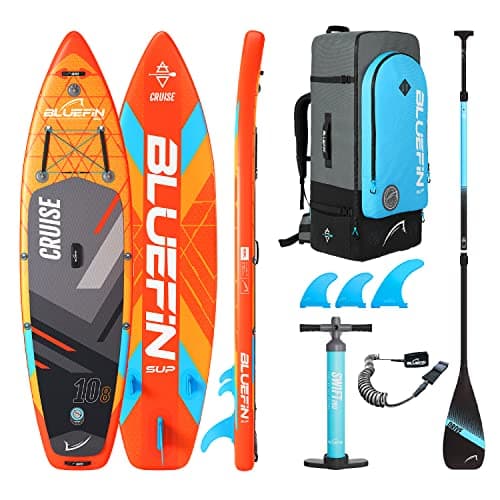
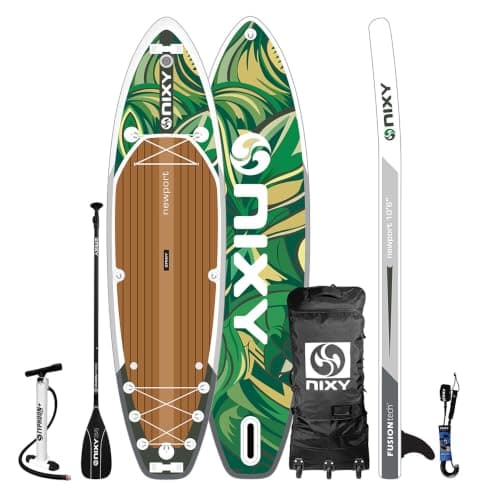
NIXY Newport G5
Three hundred liters at 15 psi and 21 lb of board. The most volume of anything here, which makes it the most stable and, not coincidentally, the longest to pump.
Three hundred liters of volume under a 33 in deck is the most forgiving platform we hold figures for, and forgiving is most of what decides whether a board gets used twice or twenty times. NIXY publishes a volume, a capacity and a three-year warranty, which puts it in the better half of this category on disclosure alone. The cons are real: that same 300 L is the largest hand-pump job we can compute at 192 strokes to 15 psi, and at 21 lb it is tied for the heaviest board here.
The trade-off
That 300 L is the reason it floats anybody and the reason it is the hardest hand-pump job in this registry. Buy it with an electric pump or plan for the arithmetic.
#ad We earn a commission if you buy through this link, at no extra cost to you. It never changes the ranking. How this site is funded. Prices checked September 12, 2026.
NIXY Newport G5 published specifications
Weight (hull or board)
21 lb
Weight (full system)
Not published
Packed size
Not published
Packed linear inches
Not published
Inflated
10 ft 6 in x 33 in
Capacity
300 lb
Working pressure
15 psi
Floor pressure
Not published
Volume
300 L
Material
Dual-layer FusionTech laminated woven drop-stitch
Chambers
1
Valves
Not published
Warranty
3 years
Computed · pump load
About 192 strokes on a 2 L dual-action hand pump to reach 15 psi, roughly 4.8 minutes at a steady 40 strokes a minute.
300 L needs 606 L of free air: 111 double-action strokes to 7 psi, then 82 single-action. Method.
Two hundred and sixty liters, a 330 lb rider limit and a five-year warranty -- the longest warranty term published by anyone in this registry.
A five-year warranty is the longest published term in our registry and the clearest signal any brand here gives about expected life -- on a page about whether these are worth the money, a manufacturer willing to stand behind it for five years is the strongest evidence available. It is also rated to 330 lb, the highest figure we list, from 260 liters. The con is that 260 L under a 32 in deck is less buoyancy than the Newport gives you, so it is the less planted board of the two.
The trade-off
Bluefin quotes a recommended 15 to 18 psi and a 28 psi test pressure. The higher you go the stiffer it gets and the longer the pumping takes; the top of that range is a lot of strokes.
#ad We earn a commission if you buy through this link, at no extra cost to you. It never changes the ranking. How this site is funded. Prices checked September 12, 2026.
Bluefin Cruise 10'8 published specifications
Weight (hull or board)
20 lb
Weight (full system)
Not published
Packed size
Not published
Packed linear inches
Not published
Inflated
10 ft 8 in x 32 in
Capacity
330 lb
Working pressure
15 psi
Floor pressure
Not published
Volume
260 L
Material
ESL drop-stitch
Chambers
1
Valves
Not published
Warranty
5 years
Computed · pump load
About 167 strokes on a 2 L dual-action hand pump to reach 15 psi, roughly 4.2 minutes at a steady 40 strokes a minute.
260 L needs 525 L of free air: 96 double-action strokes to 7 psi, then 71 single-action. Method.
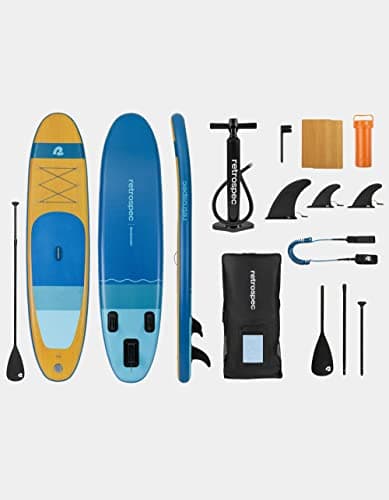
Seventeen and a half pounds, a 12 to 15 psi working range and a 275 lb rider limit, at the price end of the category where most brands publish almost nothing.
Seventeen and a half pounds is the lightest full-size board we cover and it sits at the accessible end of the market, which makes it the lowest-risk answer to a question you are not sure about yet. The con is disclosure, and it is the reason it is third rather than first: Retrospec publishes no volume, no packed size and no warranty term, so three of the four figures this site normally ranks on are simply absent.
The trade-off
Retrospec publishes no board volume, so the inflation question cannot be answered for it. On a board sold on how easy it is to get going, that is a strange omission.
#ad We earn a commission if you buy through this link, at no extra cost to you. It never changes the ranking. How this site is funded. Prices checked September 12, 2026.
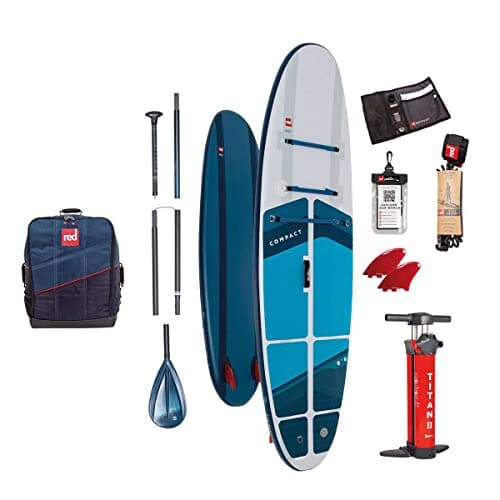
The only board here whose complete system -- board, pump, paddle, fins, leash, bag -- clears both airline limits at once on published numbers: 58.7 linear inches and 28 lb.
This is the one board in our registry whose complete 28 lb system clears both airline limits at 58.67 linear inches, and if flying with a board is the thing you are buying, nothing else here solves it. For anybody else it is the wrong purchase: 200 liters and a 210 lb rider limit are the smallest numbers in the registry on both counts, and it sits low under a heavier paddler.
The trade-off
Two hundred liters of volume and a 210 lb rider limit. It packs small because it is small, and heavier paddlers will find it sits low.
#ad We earn a commission if you buy through this link, at no extra cost to you. It never changes the ranking. How this site is funded. Prices checked September 12, 2026.
Red Paddle Co Compact 9'6 published specifications
Weight (hull or board)
16 lb
Weight (full system)
28 lb
Packed size
26 x 17.32 x 15.35 in
Packed linear inches
58.7 in
Inflated
9 ft 6 in x 32 in
Capacity
210 lb
Working pressure
15 psi
Floor pressure
Not published
Volume
200 L
Material
MSL PACT laminated drop-stitch
Chambers
1
Valves
Not published
Warranty
Not published
Computed · airline check
58.7 linear inches and 28 lb. Clears the 62-inch and 50 lb economy checked-bag limits.
26 + 17.32 + 15.35 = 58.7 in
Computed · pump load
About 128 strokes on a 2 L dual-action hand pump to reach 15 psi, roughly 3.2 minutes at a steady 40 strokes a minute.
200 L needs 404 L of free air: 74 double-action strokes to 7 psi, then 54 single-action. Method.
Modern ones are considerably better than the word 'inflatable' suggests. At 15 psi a drop-stitch board is a rigid panel rather than a soft tube, which is why an adult can stand on six inches of air. What you give up against a solid board is a little stiffness and glide, and what you get back is a board that fits in a closet and travels in a car. For most people that trade is worth making.
Are inflatable paddle boards durable?+
Durable enough that punctures are not the common failure. What actually shortens their life is UV exposure, being packed away damp, and being dragged over gravel. The one genuine structural caveat is redundancy: every inflatable paddle board in our registry is a single air chamber, so unlike a three-chamber kayak there is no backup if it does go down. Two of the eight publish a warranty term -- five years on the Bluefin Cruise 10'8, three on the NIXY Newport G5 -- and the other six publish nothing.
Who should not buy an inflatable paddle board?+
Three buyers. Anybody who has garage space and a roof rack and cares mainly about speed -- a solid board is a better board and you have nowhere to put the advantage an inflatable offers. Anybody who genuinely will not pump it, because 15 psi is 150 to 190 strokes by hand depending on the board. And anybody buying it to carry two adults, because the highest rated capacity in our registry is 330 lb and two adults plus gear is past a sensible working load on every board we cover.
Are inflatable paddle boards safe?+
The construction is sound and the practical risks are the ordinary ones: a leash you actually wear, a PFD, a forecast you checked, and conditions inside your ability. The specific thing worth knowing about an inflatable board rather than a kayak is the single chamber -- a puncture that holds air out ends the session rather than inconveniencing it, which is a reason to stay within a distance you would be willing to swim.
How long does an inflatable paddle board take to inflate?+
For the five boards in our registry whose makers publish a volume, our arithmetic puts a 2 L dual-action hand pump at 128 strokes for the 200 L Red Paddle Compact and 192 for the 300 L NIXY Newport G5 -- roughly 3.2 to 4.8 minutes at a steady 40 strokes a minute. It is a real part of the purchase and the thing most likely to stop a board being used on a whim.
Units we claim to have tested: 0
Everyone in this category says they tested twenty boats. We have not tested any, and we say so. What we did instead: pulled the published specifications and the owner's manuals, computed the pump load and the packed volume for every model that publishes enough to compute them, checked the packed sizes against the airline limits you will actually meet, and cited every page we read. The full method.
Sources
Every specification on this page was read from one of these, on the date shown. Specs change between model years, so the date matters as much as the link.