Sizing a board is one piece of arithmetic: how many liters of it are still above the water once you are standing on it.
By Scooter M. · Published October 23, 2026 · Last updated October 23, 2026
DisclosureSome links on this page are Amazon Associates links. If you buy through one we earn a commission at no extra cost to you. It does not change what we recommend or the order we recommend it in -- here is how we rank, and here is how the site is funded.
For most adults the answer is a 10 ft 6 in board of around 300 liters, and in this registry that is the NIXY Newport G5. If you are over about 200 lb, buy for the rider limit instead and the answer becomes the Bluefin Cruise 10'8 at 330 lb. If you are under about 150 lb the small board stops being a compromise, and the Red Paddle Co Compact 9'6 is genuinely the right size rather than a sacrifice.
That is the whole answer. The rest of this page is the arithmetic behind it, because the useful thing about board sizing is that it is not a matter of taste. It is a published number divided by your own weight.
The short version
Volume in liters is the sizing spec. Fresh water weighs 1 kg per liter, so every kilogram aboard sinks one liter of board below the waterline.
The rider limit is the disqualifier. Volume tells you how a board will feel; the limit tells you whether the maker will stand behind it at all.
Height is not an input. Two paddlers of the same weight need the same volume whatever their height.
Three of the eight boards in this registry publish no volume, so they cannot be sized -- only limited.
How we judged it, before any board is named
A paddle board floats you by displacing water. Fresh water weighs one kilogram per liter, so a loaded paddler of 200 lb, about 91 kg, puts 91 liters of the board under the surface. Subtract that from the published volume and what is left is the part of the board still above the water.
That reserve is what people are describing when they say a board feels stable or feels sinky. It is also the only sizing figure in this category that comes from a manufacturer rather than from a reviewer's impression, which is why this page ranks on it.
Two things we deliberately do not do. We do not publish a minimum reserve or a volume-to-weight ratio: not one manufacturer in this registry states one, so any threshold would be ours dressed up as theirs. And we do not estimate a volume for the boards that withhold it. The 20 lb of kit in the arithmetic below, meaning paddle, PFD, leash and dry bag, is the same figure the rest of this site plans with, and it is an input you should replace with your own.
Reserve volume at five paddler weights
Read down the column nearest your own weight. The figure is the liters of board left above the water with you and 20 lb of kit aboard, and "over rider limit" means the manufacturer's own ceiling is passed before any of this matters.
Liters of board remaining above the waterline, by paddler weight
Board
Volume (L)
Rider limit (lb)
120 lb paddler
150 lb paddler
180 lb paddler
210 lb paddler
240 lb paddler
NIXY Newport G5
300
300
236 L
223 L
209 L
196 L
182 L
Bluefin Cruise 10'8
260
330
196 L
183 L
169 L
156 L
142 L
Red Paddle Co Compact 9'6
200
210
136 L
123 L
109 L
Over rider limit
Over rider limit
Retrospec Weekender 10'6
Not published
275
Not published
Not published
Not published
Not published
Not published
Reserve = published volume in liters, less (paddler + 20 lb of kit) converted to kilograms at 2.20462 lb per kg. Fresh water; salt water is about 2.5 percent denser and marginally more forgiving. A blank volume is a gap in the manufacturer's specification, and we do not fill it.
Why the rider limit disqualifies before the volume decides
The two numbers answer different questions and buyers routinely read only one of them. Volume tells you how the board will behave with you on it. The rider limit is the point at which the manufacturer stops making claims, and passing it is not a matter of degree.
The Red Paddle Compact makes this concrete. It is the best travel board we cover and it stops a 210 lb paddler at the door: 210 lb plus 20 lb of kit is 230 lb against a published 210 lb limit. No amount of reserve-volume arithmetic rescues that, and it is the most common sizing mistake in the category. The board that is easiest to carry gets bought by the person least able to float it.
At the other end, the Bluefin Cruise 10'8 has the only limit here with room left at 240 lb. Its 260 liters is less board than the NIXY's 300, and for a heavy paddler that is the right trade, because the figure that runs out first is the limit.
Length and width, and why neither is the sizing spec
Length changes behavior, not capacity. A longer waterline holds a line better and carries speed; a shorter one turns more willingly and packs smaller. The distance-paddling page ranks this registry on exactly that axis, and none of it changes how high you float.
Width is the one spec that genuinely works alongside volume, because it decides how far you can move your weight before the rail goes under. In this registry it is close to a constant: every currently-buyable board is 32 inches except the NIXY at 33. It separates almost nothing here, and the volume figure does the work.
Height is not an input at all. The misconception survives because taller paddlers are on average heavier, and it is the weight doing the work in that correlation.
The boards that cannot be sized
Three of the eight boards in our registry publish no volume: the Retrospec Weekender 10'6, the ROC Explorer 10' and the iROCKER Nautical 10'6. For those, the rider limit is the only sizing figure that exists.
The Retrospec is still on this page because its 275 lb limit is real and its price is live, and because buying on a limit alone is a legitimate decision as long as you know that is what you are doing. What you cannot do is compare it with the NIXY on how it will feel underfoot, because one of the two numbers is missing.
The pattern matches what the budget end withholds generally: volume, packed size and warranty term are the three specs that go missing, and they are the three that would let you compare a cheap board with an expensive one.
Bigger is not better, and the pump is why
Reserve volume has a cost, and it is paid every single time you go out. The NIXY's 300 liters is roughly 190 strokes on a 2 L dual-action hand pump to reach 15 psi; the Red Paddle Compact's 200 liters is about 128. The full stroke model is here.
So the right size is the smallest board that floats you properly, not the largest one you can afford. A light paddler on a 300 L board has bought sixty extra strokes a session and four extra pounds to carry, in exchange for buoyancy they were never going to use.
What this page is not
It is not a first-board recommendation. The beginners page asks a different question, which board is most forgiving while you learn, and it reaches a different conclusion about the Red Paddle Compact: it tells first-timers to avoid it at any weight. This page asks only whether a board fits you. Both can be true at once, and the Compact is the clearest case of it.
Read next
Paddle boards for beginnersWhich board is most forgiving, which is a different question from which one fits.
#ad Buy links are tagged Amazon Associates links. We earn a commission at no cost to you and it never changes the order.
The picks in full
#1 · Best for most adults
NIXY Newport G5
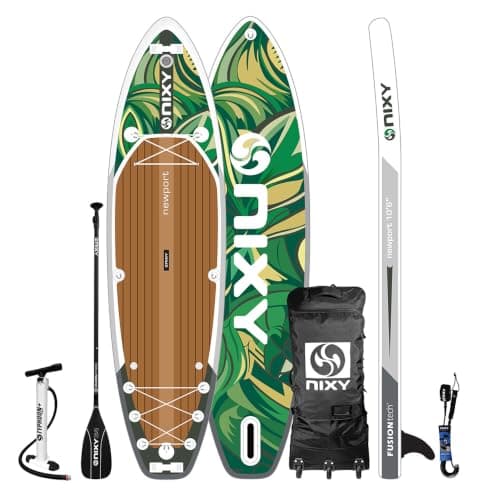
Three hundred liters at 15 psi and 21 lb of board. The most volume of anything here, which makes it the most stable and, not coincidentally, the longest to pump.
Three hundred liters against a 300 lb rider limit is the most board of anything here that is currently buyable, and at 33 inches it is also the widest. For a 180 lb paddler carrying 20 lb of kit that leaves 209 liters of board still above the water, the largest reserve in this registry, and the reason it is the size to buy if you only want to make this decision once. Two honest cons. It is the most pumping on the site at roughly 190 strokes on a 2 L hand pump, and at 21 lb it is the heaviest board we cover, so the thing that makes it forgiving on the water is the same thing that makes it least pleasant to carry to it.
The trade-off
That 300 L is the reason it floats anybody and the reason it is the hardest hand-pump job in this registry. Buy it with an electric pump or plan for the arithmetic.
#ad We earn a commission if you buy through this link, at no extra cost to you. It never changes the ranking. How this site is funded. Prices checked October 29, 2026.
NIXY Newport G5 published specifications
Weight (hull or board)
21 lb
Weight (full system)
Not published
Packed size
Not published
Packed linear inches
Not published
Inflated
10 ft 6 in x 33 in
Capacity
300 lb
Working pressure
15 psi
Floor pressure
Not published
Volume
300 L
Material
Dual-layer FusionTech laminated woven drop-stitch
Chambers
1
Valves
Not published
Warranty
3 years
Computed · pump load
About 192 strokes on a 2 L dual-action hand pump to reach 15 psi, roughly 4.8 minutes at a steady 40 strokes a minute.
300 L needs 606 L of free air: 111 double-action strokes to 7 psi, then 82 single-action. Method.
No photoWe have no photograph of this exact model that we can honestly publish
#2 · Best for a heavier paddler
Bluefin Cruise 10'8
Two hundred and sixty liters, a 330 lb rider limit and a five-year warranty -- the longest warranty term published by anyone in this registry.
The 330 lb rider limit is the highest published in this registry and the only one that still has headroom at a 240 lb paddler, where it holds 142 liters in reserve. Two hundred and sixty liters is less board underfoot than the NIXY, but it is the figure attached to the ceiling that actually matters once you are over 200 lb: the limit, not the volume, is what runs out first. Cons: there is no current Amazon listing for this model, so the buy link is a tagged search rather than a product page, and Bluefin publishes no packed size at all, which makes it the one board here you cannot plan a flight around.
The trade-off
Bluefin quotes a recommended 15 to 18 psi and a 28 psi test pressure. The higher you go the stiffer it gets and the longer the pumping takes; the top of that range is a lot of strokes.
#ad We earn a commission if you buy through this link, at no extra cost to you. It never changes the ranking. How this site is funded. Prices checked October 29, 2026.
Bluefin Cruise 10'8 published specifications
Weight (hull or board)
20 lb
Weight (full system)
Not published
Packed size
Not published
Packed linear inches
Not published
Inflated
10 ft 8 in x 32 in
Capacity
330 lb
Working pressure
15 psi
Floor pressure
Not published
Volume
260 L
Material
ESL drop-stitch
Chambers
1
Valves
Not published
Warranty
5 years
Computed · pump load
About 167 strokes on a 2 L dual-action hand pump to reach 15 psi, roughly 4.2 minutes at a steady 40 strokes a minute.
260 L needs 525 L of free air: 96 double-action strokes to 7 psi, then 71 single-action. Method.
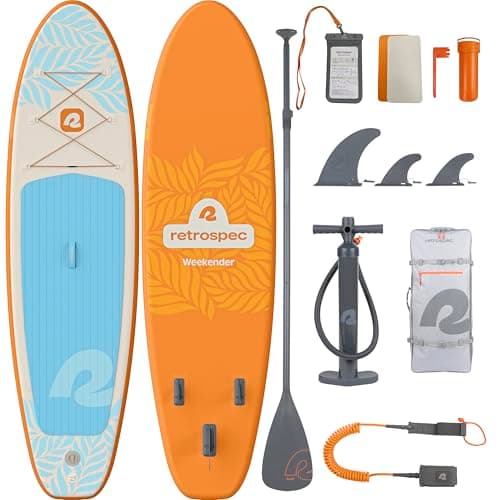
Seventeen and a half pounds, a 12 to 15 psi working range and a 275 lb rider limit, at the price end of the category where most brands publish almost nothing.
Thirty-two inches wide and a 275 lb rider limit, which clears a 240 lb paddler with kit, and a published 12 to 15 psi range that lets you run it softer while you find out whether you like this at all. It is also one of only two boards in this registry with a live Amazon price, so what you pay is visible before you commit. The con is the one this page is built on: Retrospec publishes no volume, so there is no reserve figure for it and nobody can size it properly. You are buying on the rider limit alone.
The trade-off
Retrospec publishes no board volume, so the inflation question cannot be answered for it. On a board sold on how easy it is to get going, that is a strange omission.
#ad We earn a commission if you buy through this link, at no extra cost to you. It never changes the ranking. How this site is funded. Prices checked October 29, 2026.
No photoWe have no photograph of this exact model that we can honestly publish
#4 · Best for a light paddler, wrong for most
Red Paddle Co Compact 9'6
The only board here whose complete system -- board, pump, paddle, fins, leash, bag -- clears both airline limits at once on published numbers: 58.7 linear inches and 28 lb.
Two hundred liters and a 210 lb rider limit make this the smallest board we cover, and for a paddler under about 150 lb that is the correct size rather than a compromise. One hundred and twenty-three liters of reserve at 150 lb is a properly floated board, and nothing else here folds as small. The con is arithmetic and it is unforgiving: add the same 20 lb of kit to a 210 lb paddler and you are at 230 lb against a 210 lb limit, which is past the line the manufacturer drew. This is the board most often bought by the wrong person, because it is the best one to travel with.
The trade-off
Two hundred liters of volume and a 210 lb rider limit. It packs small because it is small, and heavier paddlers will find it sits low.
#ad We earn a commission if you buy through this link, at no extra cost to you. It never changes the ranking. How this site is funded. Prices checked October 29, 2026.
Red Paddle Co Compact 9'6 published specifications
Weight (hull or board)
16 lb
Weight (full system)
28 lb
Packed size
26 x 17.32 x 15.35 in
Packed linear inches
58.7 in
Inflated
9 ft 6 in x 32 in
Capacity
210 lb
Working pressure
15 psi
Floor pressure
Not published
Volume
200 L
Material
MSL PACT laminated drop-stitch
Chambers
1
Valves
Not published
Warranty
Not published
Computed · airline check
58.7 linear inches and 28 lb. Clears the 62-inch and 50 lb economy checked-bag limits.
26 + 17.32 + 15.35 = 58.7 in
Computed · pump load
About 128 strokes on a 2 L dual-action hand pump to reach 15 psi, roughly 3.2 minutes at a steady 40 strokes a minute.
200 L needs 404 L of free air: 74 double-action strokes to 7 psi, then 54 single-action. Method.
Work it in liters rather than feet. Fresh water weighs one kilogram per liter, so your mass plus your kit sinks that many liters of the board below the waterline, and what is left is the reserve holding you up. A 180 lb paddler with 20 lb of kit displaces about 91 liters: on the 300 L NIXY Newport G5 that leaves 209 liters in reserve, on the 260 L Bluefin Cruise 10'8 it leaves 169, and on the 200 L Red Paddle Co Compact 9'6 it leaves 109. Then check the second number, the manufacturer's rider limit, because that is the one that disqualifies a board outright.
What size paddle board do I need for my height?+
Height is not the input, which is why the question so often gets a vague answer. Board length changes how straight a board tracks and how quickly it turns; it is your weight, not your height, that decides whether the board floats you high enough to stand on comfortably. Two paddlers of the same weight and very different heights need the same volume. If you are tall and light you are a small-board paddler who will appreciate a longer waterline, which is what the 11 ft class is for.
What size paddle board do I need for a 250 lb rider?+
At 250 lb with 20 lb of kit you are at 270 lb loaded, and that rules out most of this registry on the published rider limit alone. The Bluefin Cruise 10'8 at 330 lb is the only board we cover with real headroom there; the Retrospec Weekender's 275 lb limit clears it by 5 lb, which is not margin. A rider limit is a manufacturer's maximum rather than a target, so a heavier paddler should be reading the limit first and the volume second.
What size paddle board do two people need?+
A bigger one than anything in this registry. All eight boards we hold specs for are single-rider boards, and putting two adults on a 10 ft 6 in board passes every rider limit on this page before you add any kit. Makers do sell purpose-built tandem boards in the 15 ft class; we do not cover one, and rather than size a two-person board from single-rider figures we will say plainly that this page cannot answer that question.
How wide should an inflatable paddle board be?+
Thirty-two inches is the practical floor for an adult and 33 is better. Width and volume do different jobs: volume decides how high the board sits, width decides how far you can shift your weight before the rail goes under. The NIXY Newport G5 at 33 inches is the widest board we cover, and every other currently-buyable board in this registry is 32 inches, so on this spec the category is unusually uniform and the volume figure is doing most of the deciding.
What if the manufacturer does not publish a volume?+
Then the board cannot be sized, and that is worth knowing before you buy rather than after. Three of the eight boards in our registry, the Retrospec Weekender, the ROC Explorer and the iROCKER Nautical, publish no volume at all, which leaves the rider limit as the only sizing figure available for them. We do not estimate a volume from length, width and thickness: the taper and rail shape that estimate would need are not published either, and the result would look exactly like the numbers that are real.
Units we claim to have tested: 0
Everyone in this category says they tested twenty boats. We have not tested any, and we say so. What we did instead: pulled the published specifications and the owner's manuals, computed the pump load and the packed volume for every model that publishes enough to compute them, checked the packed sizes against the airline limits you will actually meet, and cited every page we read. The full method.
Sources
Every specification on this page was read from one of these, on the date shown. Specs change between model years, so the date matters as much as the link.