Inflatable or solid paddle board: the actual trade
One of these lives in a closet. The other is stiffer and ready the moment you reach the water. Almost everything else follows from that.
By Scooter M. · Published September 12, 2026 · Last updated September 12, 2026
DisclosureSome links on this page are Amazon Associates links. If you buy through one we earn a commission at no extra cost to you. It does not change what we recommend or the order we recommend it in -- here is how we rank, and here is how the site is funded.
This is the comparison every paddle board buyer makes, and it is usually argued badly -- by inflatable sellers pretending the stiffness gap has closed, and by solid-board purists pretending storage is not a real constraint on real lives.
One thing to state before anything else: this site holds published specifications for eight inflatable boards and none at all for solid boards. So the inflatable side of every table below is measured and cited, and the solid side is characterized rather than specified. We would rather say that plainly than invent a comparison.
The short version
Solid boards are stiffer and glide better. That gap is real and we are not going to argue it away.
Inflatables in our registry run 16 to 21 lb and roll into a bag. No solid board does either.
Pressure is what closes the stiffness gap: 15 psi across most of our registry, 18 psi on the iROCKER Nautical.
Every inflatable board here is a single air chamber. A solid board cannot deflate at all.
Setup is 128 to 192 hand-pump strokes against zero -- at both ends of every outing.
Where the solid board wins
Stiffness and glide. An epoxy-over-foam board is rigid in a way a pressurized panel is not, and over distance that shows up as less energy lost into flex and a hull that holds its line. If you intend to race, to paddle long distances, or to surf a board properly, this is the whole argument and it is decisive.
Zero setup. A solid board goes from roof rack to water in the time it takes to carry it. An inflatable needs unrolling, pumping to 15 psi and a fin fitted, then reversing all of it at the end while wet. Our arithmetic puts that at 128 to 192 strokes by hand depending on the board, and the friction is the single biggest reason boards stop getting used on a whim.
It cannot deflate. Every board in our inflatable registry is one air chamber. Out on open water a long way from shore, a board that physically cannot go down is worth something real, and we would not pretend otherwise.
Where the inflatable wins
It fits your life. This is the argument that actually decides most purchases and it is not a small one. Our registry runs 16 lb to 21 lb of board, rolling into a bag that lives in a closet, a car boot or a wardrobe. For anybody in an apartment, without a garage, or without a roof rack, the realistic alternative to an inflatable is not a solid board -- it is no board.
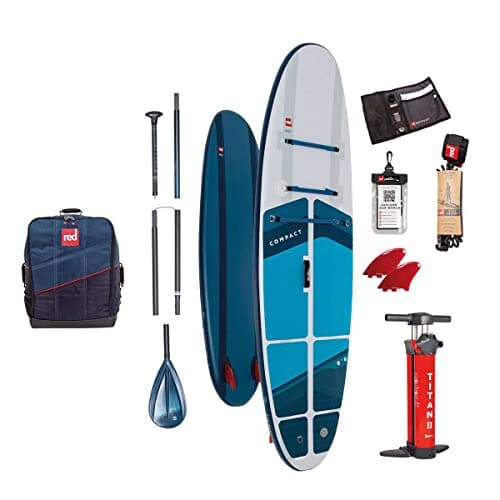
It travels. The Red Paddle Co Compact 9'6 packs to 58.67 linear inches with a complete 28 lb system, which clears both the 62-inch and 50 lb economy checked-bag limits published by United, Delta and American. No solid board can be checked as ordinary luggage at any size. The travel roundup ranks every board against both limits.
It forgives. A dropped solid board dings and a rock scrapes gel coat. A drop-stitch panel bounces. For beginners, for children, and for anybody launching off rock rather than sand, that tolerance is worth more than the stiffness it costs.
What actually closes the gap
Pressure, and it is the specification to shop on if stiffness is your worry. A drop-stitch board is only as rigid as the air inside it, so the difference between an inflatable that feels like a board and one that feels like a lilo is mostly the number on the valve.
Seven of our eight boards run 15 psi. The iROCKER Nautical 10'6 runs 18, which is the highest figure in our registry and the reason it earns a pick here despite a middling capacity. Under-inflate any of them and you get exactly the flex that gives the category its bad reputation, which makes reaching the published pressure less optional than people treat it.
Volume does the other half. More liters is more buoyancy, which is a board that sits higher and feels more planted under load. Five of our eight publish it, and it ranges from 200 L to 300 L.
The comparison, laid out
Inflatable and solid paddle boards on the axes that decide the purchase
Inflatable (our registry)
Solid
Board weight
16 to 21 lb
Not held -- typically heavier
Storage
Rolls into a bag
Full length, permanently
Transport
Car boot or closet
Roof rack
Air travel
One board here clears both limits
Not checkable as ordinary luggage
Setup each outing
128 to 192 strokes by hand
None
Stiffness
15 to 18 psi panel
Rigid by construction
Redundancy
Single chamber, no backup
Cannot deflate
Impact tolerance
High -- it deforms
Dings and gel-coat damage
Published warranty
5 yr and 3 yr; six brands publish none
Not held
The inflatable column is drawn from the eight boards in our registry and every figure is a manufacturer's own. The solid column is descriptive: this site holds no published specifications for solid boards, so nothing there is presented as a measurement.
So which one
Buy solid if you have somewhere to keep it, a way to carry it, and speed or surf is the point. It is the better board and the people who tell you otherwise are usually selling inflatables.
Buy inflatable if storage or transport is a genuine constraint, if you fly with gear, if the board has to share a car with luggage, or if the alternative is not buying a board at all. The stiffness gap is real and for ordinary recreational paddling it is now small enough to lose to the practical advantages.
Ranked on weight. Tap any row to jump to the full write-up.
#
Product
Best for
Weight
Price
1
The inflatable that gives up leastNIXY Newport G5That 300 L is the reason it floats anybody and the reason it is the hardest hand-pump job in this registry.
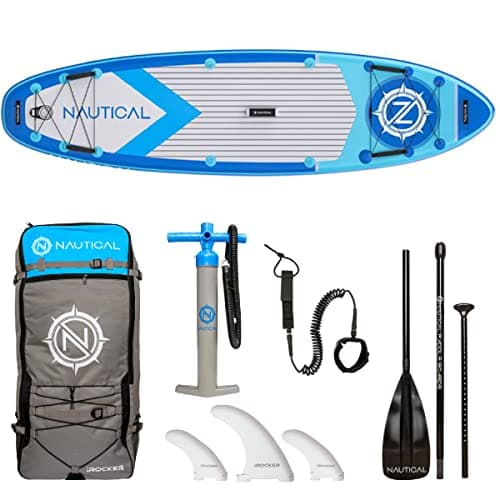
The stiffest deck we listiROCKER Nautical 10'6Those two inches are the difference between a checked bag and an oversize fee, and iROCKER is the only brand here honest enough to let you work that out in advance..
#ad Buy links are tagged Amazon Associates links. We earn a commission at no cost to you and it never changes the order.
The picks in full
#1 · The inflatable that gives up least
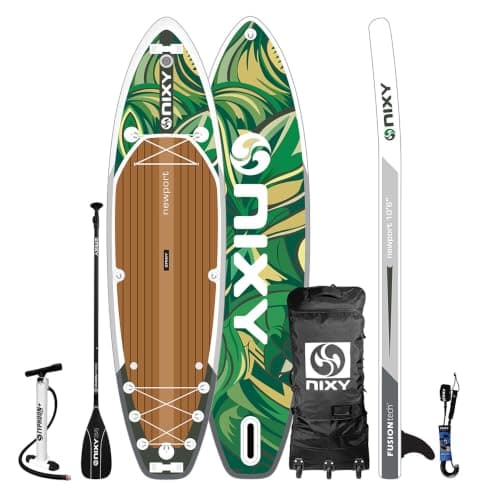
NIXY Newport G5
Three hundred liters at 15 psi and 21 lb of board. The most volume of anything here, which makes it the most stable and, not coincidentally, the longest to pump.
Three hundred liters at 15 psi under a 33 in deck is the most forgiving platform we hold figures for, and volume is the specification that closes most of the gap to a solid board for an ordinary recreational paddler. A published three-year warranty is more than six of the eight brands here offer. The con is the one every inflatable carries and this one carries most: 300 L is the largest hand-pump job we can compute, at 192 strokes to 15 psi.
The trade-off
That 300 L is the reason it floats anybody and the reason it is the hardest hand-pump job in this registry. Buy it with an electric pump or plan for the arithmetic.
#ad We earn a commission if you buy through this link, at no extra cost to you. It never changes the ranking. How this site is funded. Prices checked September 12, 2026.
NIXY Newport G5 published specifications
Weight (hull or board)
21 lb
Weight (full system)
Not published
Packed size
Not published
Packed linear inches
Not published
Inflated
10 ft 6 in x 33 in
Capacity
300 lb
Working pressure
15 psi
Floor pressure
Not published
Volume
300 L
Material
Dual-layer FusionTech laminated woven drop-stitch
Chambers
1
Valves
Not published
Warranty
3 years
Computed · pump load
About 192 strokes on a 2 L dual-action hand pump to reach 15 psi, roughly 4.8 minutes at a steady 40 strokes a minute.
300 L needs 606 L of free air: 111 double-action strokes to 7 psi, then 82 single-action. Method.
The rare brand that publishes its bag dimensions: 36 x 16 x 12 inches, which is 64 linear inches and therefore two inches over the standard checked-bag line.
Eighteen psi is the highest working pressure in our registry and pressure is precisely the variable that decides how close an inflatable gets to a solid board underfoot -- a stiffer panel flexes less in the middle, which is the single most common complaint about inflatables. It is also one of only two boards here that publishes a packed size. Two cons: 240 lb is the second-lowest rated capacity we cover, and iROCKER publishes no volume figure, so the buoyancy behind that rating cannot be checked.
The trade-off
Those two inches are the difference between a checked bag and an oversize fee, and iROCKER is the only brand here honest enough to let you work that out in advance.
#ad We earn a commission if you buy through this link, at no extra cost to you. It never changes the ranking. How this site is funded. Prices checked September 12, 2026.
iROCKER Nautical 10'6 published specifications
Weight (hull or board)
20 lb
Weight (full system)
27 lb
Packed size
36 x 16 x 12 in
Packed linear inches
64 in
Inflated
10 ft 6 in x 32 in
Capacity
240 lb
Working pressure
18 psi
Floor pressure
Not published
Volume
Not published
Material
Drop-stitch PVC
Chambers
1
Valves
Not published
Warranty
Not published
Computed · airline check
64 linear inches and 27 lb. Past at least one of the 62-inch / 50 lb economy checked-bag limits.
The only board here whose complete system -- board, pump, paddle, fins, leash, bag -- clears both airline limits at once on published numbers: 58.7 linear inches and 28 lb.
Fifty-eight point six seven linear inches and a complete 28 lb system, which clears both the 62-inch and 50 lb economy checked-bag limits. No solid board of any size does this, which makes it the clearest example on the site of a problem only an inflatable solves. The cons are the price of that: 200 liters and a 210 lb rider limit are the smallest figures in our registry, and it sits low under a heavier paddler.
The trade-off
Two hundred liters of volume and a 210 lb rider limit. It packs small because it is small, and heavier paddlers will find it sits low.
#ad We earn a commission if you buy through this link, at no extra cost to you. It never changes the ranking. How this site is funded. Prices checked September 12, 2026.
Red Paddle Co Compact 9'6 published specifications
Weight (hull or board)
16 lb
Weight (full system)
28 lb
Packed size
26 x 17.32 x 15.35 in
Packed linear inches
58.7 in
Inflated
9 ft 6 in x 32 in
Capacity
210 lb
Working pressure
15 psi
Floor pressure
Not published
Volume
200 L
Material
MSL PACT laminated drop-stitch
Chambers
1
Valves
Not published
Warranty
Not published
Computed · airline check
58.7 linear inches and 28 lb. Clears the 62-inch and 50 lb economy checked-bag limits.
26 + 17.32 + 15.35 = 58.7 in
Computed · pump load
About 128 strokes on a 2 L dual-action hand pump to reach 15 psi, roughly 3.2 minutes at a steady 40 strokes a minute.
200 L needs 404 L of free air: 74 double-action strokes to 7 psi, then 54 single-action. Method.
Which is better, an inflatable or a solid paddle board?+
A solid board is the better board on the water and an inflatable is the better purchase for most people, which is not a contradiction. Solid boards are stiffer and glide better. Inflatables roll into a bag, live in a closet, travel in a hatchback and can be checked as luggage. If you have garage space and a roof rack and speed matters to you, buy solid. If storage or transport is a real constraint, the inflatable is not a compromise so much as the only version of the product that fits your life.
Are inflatable paddle boards as stiff as solid ones?+
No, and anybody claiming otherwise is selling something. A drop-stitch panel at 15 psi is genuinely rigid -- it is why an adult can stand on six inches of air -- but it is not epoxy over foam. Pressure is the variable that closes the gap: the iROCKER Nautical 10'6 runs 18 psi against the 15 psi that the other seven boards in our registry use, and more pressure is less flex along the middle of the board.
Do inflatable paddle boards pop?+
Rarely, and the more useful framing is what happens if one does. Every inflatable paddle board in our registry is a single air chamber, so there is no redundancy -- a puncture that holds air out ends the session. A solid board cannot deflate at all, which is a genuine safety advantage a long way from shore. Against that, a solid board can be holed and waterlogged, and repairing one is a considerably bigger job than a patch.
How much longer does an inflatable take to get on the water?+
For the five boards whose makers publish a volume, our arithmetic puts a 2 L dual-action hand pump at 128 to 192 strokes to reach 15 psi -- roughly 3.2 to 4.8 minutes at a steady rate, plus unrolling and fitting a fin. A solid board is zero. That difference at both ends of every outing is the real cost of the category, and it is the reason electric pumps exist.
Which holds its value or lasts longer?+
We cannot tell you honestly, and we are not going to guess. No manufacturer in our registry publishes a durability measurement of any kind, and we hold no specifications for solid boards at all. What we can report is that two of our eight inflatable brands publish a warranty term -- five years and three years -- and the other six publish nothing.
Units we claim to have tested: 0
Everyone in this category says they tested twenty boats. We have not tested any, and we say so. What we did instead: pulled the published specifications and the owner's manuals, computed the pump load and the packed volume for every model that publishes enough to compute them, checked the packed sizes against the airline limits you will actually meet, and cited every page we read. The full method.
Sources
Every specification on this page was read from one of these, on the date shown. Specs change between model years, so the date matters as much as the link.