Skip to content
Stroke & Stern

Questions people actually ask

The ones that come up before you have picked a category — plus the ones about how this site works, which are fair to ask of anybody publishing rankings.
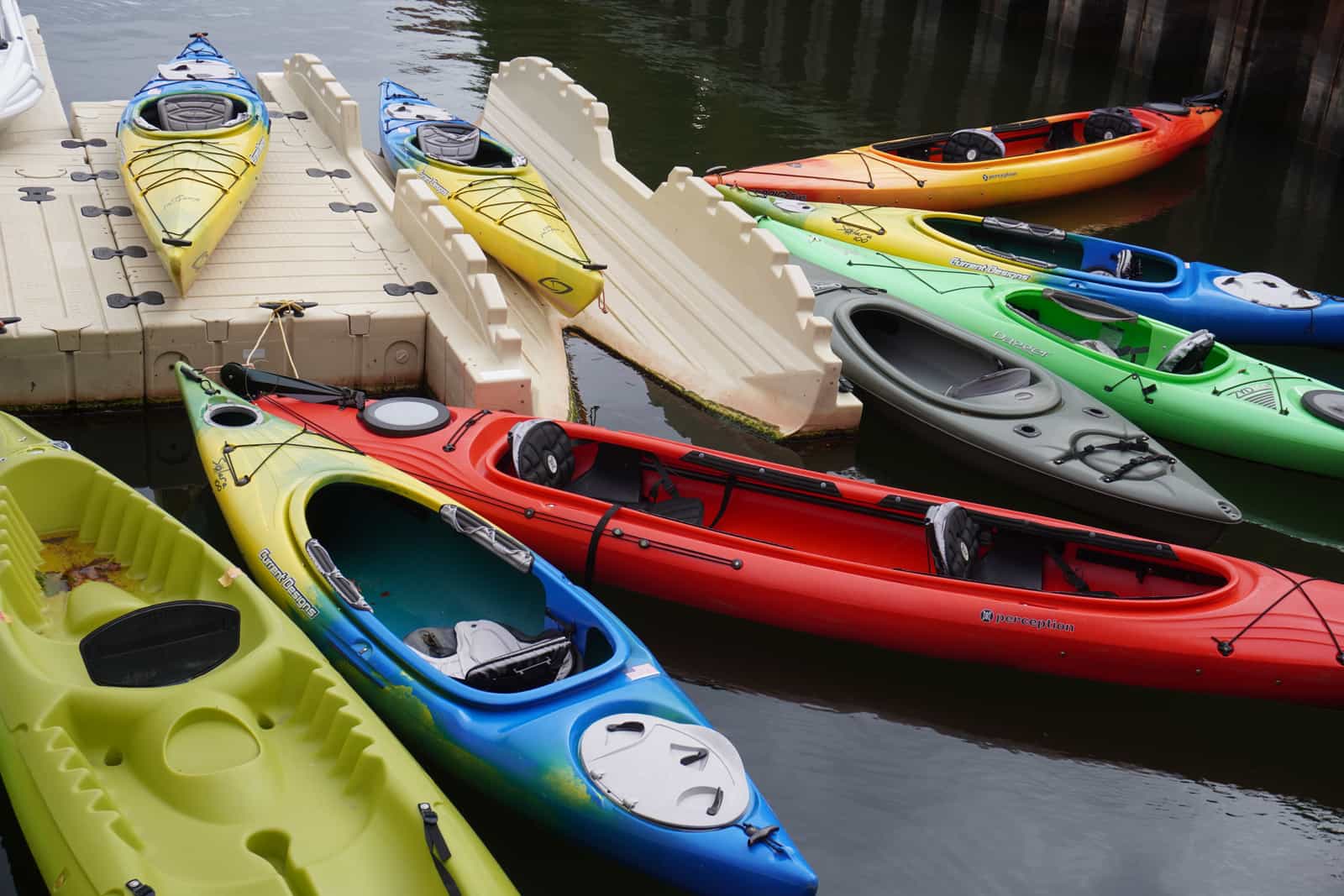
Colorful kayaks lined up along a waterfront dock

Every answer below links to the page that covers it properly. If your question is about a specific model, the review pages carry the full published specification for each one, and if it is about our method, how we rank sets it out with the formulas.

Choosing what to buy

Inflatable kayak or inflatable paddle board — which should I buy first?
The kayak, if ease matters most: you sit down, which removes the balance problem entirely, and a 34-inch-beam boat is very hard to tip at rest. Kayaks also carry roughly twice the payload (650 lb for the best boat in our registry against 330 lb for the best board) and inflate far faster, because they run 1.1 to 6 psi against a board's 15. A board puts you standing, which is the whole reason people love them.
How small do these actually pack?
It varies enormously, and many manufacturers do not say. Across our registry the inflatable kayaks that publish a packed size run from 27 linear inches (Advanced Elements PackLite, 11 x 11 x 5 in) to 58 (Sea Eagle SE370). Only two of eight paddle boards publish the figure at all: the Red Paddle Co Compact 9'6 at 58.7 linear inches and the iROCKER Nautical at 64.
Can I take one on a plane?
As checked luggage, if it clears both limits. United, Delta and American all publish the same economy standard: 62 linear inches (length + width + height) and 50 lb. Both apply — clearing one is not enough. Two products in our registry publish figures that clear both with the full kit inside: the Advanced Elements PackLite (27 in, 7 lb) and the Red Paddle Co Compact 9'6 (58.7 in, 28 lb).
How much weight capacity do I need?
Add your own weight plus your gear, then aim for about two thirds of the product's rating rather than all of it. A rating is the point at which the manufacturer stops making claims, not a comfortable working load — a boat or board loaded to its maximum sits low, ships water in any chop, and handles badly.
Are cheap inflatables any good?
On the numbers they publish, often yes: the ROC Explorer's 300 lb rider limit at 17.5 lb is competitive with boards costing several times more. What the budget end withholds is systematic — volume, packed size and warranty term go missing together, and those are precisely the three specs that would let you compare a cheap product against an expensive one.
Why do your buy buttons say 'Check price' instead of showing a price?
Because we only render prices that come from a live data feed, and that feed is not connected on this build yet. A remembered price is worse than no price: it is wrong at an unknown rate, and one invented number quietly devalues every other figure in the table. When the feed is live, prices appear with the date they were checked.

Pressure, pumping and packing

How long does an inflatable paddle board take to inflate?
For the five boards in our registry whose makers publish a volume, roughly 128 to 192 full strokes on a 2 L dual-action hand pump to reach 15 psi — about 3.2 to 4.8 minutes at a steady 40 strokes a minute that almost nobody sustains. A two-stage electric pump takes 3.5 to 5.2 minutes, which is barely faster in clock time. What it saves is effort, not minutes.
Why can't you tell me how long an inflatable kayak takes to inflate?
Because not one inflatable kayak manufacturer in our registry publishes a chamber volume, and volume is the input the whole calculation runs on. We could estimate it from tube diameter and hull length, but that estimate would carry assumptions we cannot check and would look exactly like the numbers we did not estimate. Sea Eagle's eight-minute claim for the SE370 is the only inflation figure any kayak brand here publishes.
What PSI should I inflate to?
Whatever the manufacturer states. Inflatable kayaks in our registry run 1.1 to 6 psi; paddle boards run 15 to 18. Under-inflation is the common mistake and the one people misdiagnose — a board at 10 psi feels firm to a hand and still bends noticeably under a standing adult, which most people blame on the board rather than the pressure.
Do I need to buy a separate pump?
Not to start with — every kayak and board in our registry ships with one. It is also the first thing most people replace. The thing to check before buying any pump is its pressure ceiling against your product's target: two of the four pumps we hold specs for stop short of a standard 15 psi board, which makes them excellent kayak pumps and the wrong purchase for a board.
Why won't my board fit back in its bag?
Trapped air, almost always. A board that feels flat still holds a surprising volume, and the roll has to start at the end furthest from the valve so the air is pushed out ahead of it. Rolling the wrong way traps air behind the roll and adds several inches to the finished diameter. Take the fins off first, too — a fin left in place makes the roll oval.

The arithmetic behind these is in how long an inflatable takes to inflate, the pressures are charted in the PSI chart, and the pump choice is worked through in electric versus hand pump.

About this site

Have you actually tested any of this gear?
No. We own none of it, we have paddled none of it, and there is no test lab. That is stated on every page that ranks anything, because it is the first thing a reader deserves to know. Five of the eleven competitors we measured put 'Tested' in their page titles; we never will.
Then why should I trust your rankings?
Because you can check them. Every specification is cited to the manufacturer page it came from, with the date it was read. Every derived figure prints its formula and its inputs beside the result. If we have made an arithmetic error you can find it in about a minute, which is not true of 'we tested twenty boats and liked this one'.
What happens when a manufacturer doesn't publish a figure?
The cell says 'Not published' and stays empty. We do not estimate it, infer it from a similar product, or carry it across from a competitor's table. In this category those blanks are frequently the most informative thing on the page — three of eight kayaks publishing no working pressure is a finding, not a formatting problem.
Does affiliate commission affect what you recommend?
No, and there is a structural reason it cannot in any interesting way: every product on this site links to Amazon under the same Associates tag, so there is no higher-paying merchant to steer you toward. We also take no paid placement and accept no free product. If we ever join a network with meaningfully different per-merchant rates, the disclosure page will say so before any link does.
Why are there no star ratings or scores out of ten?
A score would be an evaluation of gear nobody here has handled. Where a score column would sit, our comparison tables carry the ranking figure instead — packed linear inches, pounds, strokes. That is a fact with a manufacturer's name attached to it, and it is more useful to a buyer anyway.
I think one of your numbers is wrong. How do I tell you?
Please do — it is the most useful message we receive. The contact form has a spec-correction option, and a link to the manufacturer page showing the correct figure makes it much faster to act on. Confirmed errors are corrected within seven days, visibly rather than quietly.

Still unanswered? Ask us — corrections especially. See also our editorial policy and how the site is funded.