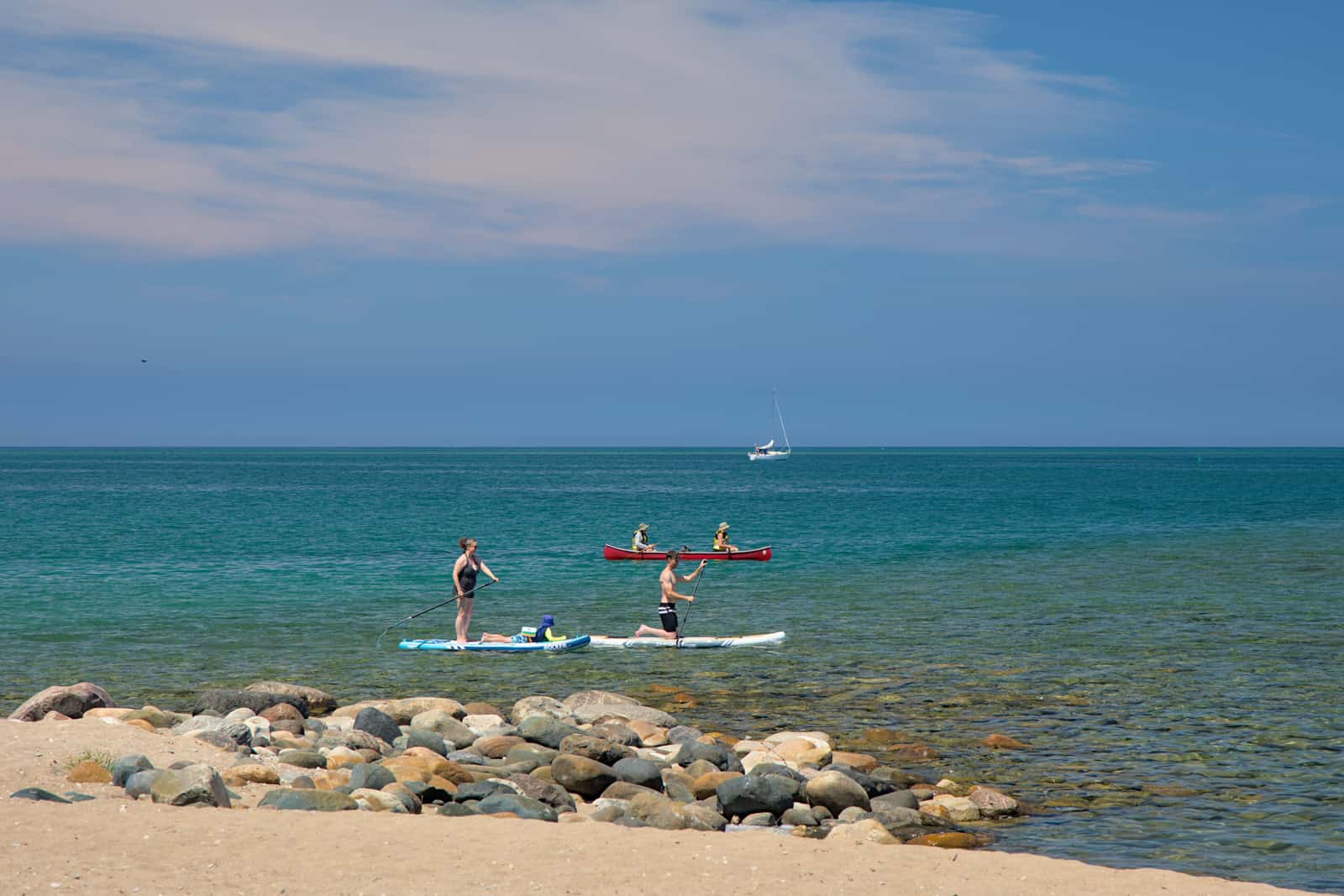
Sitting versus standing sounds like a preference. On published numbers it is a difference in capacity, pack size and about fifteen minutes of pumping.
By Scooter M. · Published September 2, 2026 · Last updated September 2, 2026
DisclosureSome links on this page are Amazon Associates links. If you buy through one we earn a commission at no extra cost to you. It does not change what we recommend or the order we recommend it in -- here is how we rank, and here is how the site is funded.
If you have not bought either yet, this is a more useful page than any model ranking. The two products look adjacent -- both inflate, both pack down, both use a paddle -- and they suit genuinely different days out.
The short version
Kayaks carry roughly twice the payload: 650 lb on the SE370 against 330 lb on the best board here.
Kayaks pack smaller and are far quicker to inflate, because they run 1.1 to 6 psi against a board's 15.
Boards put you standing, which is a better view and a more engaging way to move.
Kayaks are usable in five minutes. Boards take an afternoon to get comfortable on.
The two categories on published numbers
Inflatable kayaks against inflatable paddle boards, best-in-registry for each
Inflatable kayak
Inflatable paddle board
Best capacity here
650 lb (Sea Eagle SE370)
330 lb (Bluefin Cruise 10'8)
Weight range here
4 to 48 lb
16 to 21 lb
Smallest packed
27 linear in (PackLite)
58.7 linear in (Red Paddle Compact)
Working pressure
1.1 to 6 psi
15 to 18 psi
Hand-pump effort
Minutes, low effort
128 to 192 strokes
Position
Seated, low
Standing, high
Learning curve
Minutes
An afternoon
Every figure is drawn from the manufacturers' published specifications for the products in our registry. Stroke counts are computed from published board volumes against a published 2 L pump cylinder.
The pressure row explains most of the difference
A board is a drop-stitch panel that has to be rigid enough to stand on, and rigidity in a flat panel comes from pressure. Fifteen psi is what it takes.
A kayak is a set of round tubes, and round tubes hold their shape at very low pressure -- the Sea Eagle SE370 runs at 1.1 psi. That single specification is why kayaks inflate in minutes and boards take a real physical effort, and it is worth internalizing before you buy, because you will do it at both ends of every outing. The arithmetic is here.
Capacity is the other decider
Six hundred and fifty pounds against 330 is not a marginal difference. A kayak will take you, a second person and a weekend's camping gear. A board will take you and a dry bag, and everything on the deck gets wet.
If you already know your paddling involves carrying things -- a cooler, a child, a dog, camping kit -- the kayak wins before any of the other rows matter.
What a board is genuinely better at
Standing. It is a different way of being on water: you see into it, you see over things, and it engages your whole body rather than just your arms and torso. People who love paddle boarding love it for reasons a spec table does not capture, and it would be dishonest to pretend the capacity column settles the question.
A board is also considerably lighter as a category -- 16 to 21 lb against 4 to 48 -- and far more consistent, which makes it a simpler thing to buy.
Or do both badly
A high-volume board with a manufacturer seat kit gives you a wide, slow kayak when your legs get tired. It is a real option and it is a compromise in both directions -- we went through the numbers on it here.
#ad Buy links are tagged Amazon Associates links. We earn a commission at no cost to you and it never changes the order.
The picks in full
No photoWe have no photograph of this exact model that we can honestly publish
#1 · If you want to carry things
Sea Eagle SE370
Twelve and a half feet of boat, 650 lb of capacity, 32 lb of hull, and it runs at 1.1 psi -- the lowest working pressure of anything here, which is why it is also one of the quickest to pump.
Six hundred and fifty pounds of capacity against the best board in our registry at 330. If your paddling involves a cooler, a dog, a child or camping gear, the comparison ends right here.
The trade-off
Low pressure means a soft hull. It is forgiving and it is slow. The packed bag is 31 x 19 x 8 inches -- 58 linear inches, so it checks, but it is a bulky thing to carry through an airport.
#ad We earn a commission if you buy through this link, at no extra cost to you. It never changes the ranking. How this site is funded. Prices checked September 2, 2026.
Sea Eagle SE370 published specifications
Weight (hull or board)
32 lb
Weight (full system)
Not published
Packed size
31 x 19 x 8 in
Packed linear inches
58 in
Inflated
12 ft 6 in x 2 ft 10 in
Capacity
650 lb
Working pressure
1.1 psi
Floor pressure
Not published
Volume
Not published
Material
38 mil Polykrylar (K80 PVC)
Chambers
3
Valves
Five one-way air valves
Warranty
Not published
Computed · airline check
58 linear inches and 32 lb. Clears the 62-inch and 50 lb economy checked-bag limits.
No photoWe have no photograph of this exact model that we can honestly publish
#2 · If you want the view
NIXY Newport G5
Three hundred liters at 15 psi and 21 lb of board. The most volume of anything here, which makes it the most stable and, not coincidentally, the longest to pump.
Thirty-three inches wide with 300 L of volume, which is the most forgiving standing platform here. Standing is the entire reason to choose a board, and this is the board that makes it easiest.
The trade-off
That 300 L is the reason it floats anybody and the reason it is the hardest hand-pump job in this registry. Buy it with an electric pump or plan for the arithmetic.
#ad We earn a commission if you buy through this link, at no extra cost to you. It never changes the ranking. How this site is funded. Prices checked September 2, 2026.
NIXY Newport G5 published specifications
Weight (hull or board)
21 lb
Weight (full system)
Not published
Packed size
Not published
Packed linear inches
Not published
Inflated
10 ft 6 in x 33 in
Capacity
300 lb
Working pressure
15 psi
Floor pressure
Not published
Volume
300 L
Material
Dual-layer FusionTech laminated woven drop-stitch
Chambers
1
Valves
Not published
Warranty
3 years
Computed · pump load
About 192 strokes on a 2 L dual-action hand pump to reach 15 psi, roughly 4.8 minutes at a steady 40 strokes a minute.
300 L needs 606 L of free air: 111 double-action strokes to 7 psi, then 82 single-action. Method.
No photoWe have no photograph of this exact model that we can honestly publish
#3 · If pack size decides it
Advanced Elements PackLite
A 4 lb kayak that rolls to 11 x 11 x 5 inches. Nothing else in the category is close on either number, and the compromises are exactly the ones you would expect.
Twenty-seven linear inches against the smallest board in the registry at 58.7. Kayaks pack smaller than boards, and this is the extreme end of that fact.
The trade-off
At 2 psi in the side tubes and 1 psi in the floor there is very little structure here. It is a boat for getting somewhere remote, not for a windy afternoon on open water.
#ad We earn a commission if you buy through this link, at no extra cost to you. It never changes the ranking. How this site is funded. Prices checked September 2, 2026.
Advanced Elements PackLite published specifications
No photoWe have no photograph of this exact model that we can honestly publish
#4 · The board that packs like a kayak
Red Paddle Co Compact 9'6
The only board here whose complete system -- board, pump, paddle, fins, leash, bag -- clears both airline limits at once on published numbers: 58.7 linear inches and 28 lb.
58.7 linear inches and a 28 lb complete system. It is the only board here that clears both airline limits, which removes the pack-size argument from the comparison entirely.
The trade-off
Two hundred liters of volume and a 210 lb rider limit. It packs small because it is small, and heavier paddlers will find it sits low.
#ad We earn a commission if you buy through this link, at no extra cost to you. It never changes the ranking. How this site is funded. Prices checked September 2, 2026.
Red Paddle Co Compact 9'6 published specifications
Weight (hull or board)
16 lb
Weight (full system)
28 lb
Packed size
26 x 17.32 x 15.35 in
Packed linear inches
58.7 in
Inflated
9 ft 6 in x 32 in
Capacity
210 lb
Working pressure
15 psi
Floor pressure
Not published
Volume
200 L
Material
MSL PACT laminated drop-stitch
Chambers
1
Valves
Not published
Warranty
Not published
Computed · airline check
58.7 linear inches and 28 lb. Clears the 62-inch and 50 lb economy checked-bag limits.
26 + 17.32 + 15.35 = 58.7 in
Computed · pump load
About 128 strokes on a 2 L dual-action hand pump to reach 15 psi, roughly 3.2 minutes at a steady 40 strokes a minute.
200 L needs 404 L of free air: 74 double-action strokes to 7 psi, then 54 single-action. Method.
The kayak, and it is not close. You sit down, which removes the balance problem entirely, and a 34-inch-beam boat like the Sea Eagle SE370 is very hard to tip at rest. A paddle board asks you to stand on a moving object on your first attempt. Boards are learnable in an afternoon; kayaks are usable in five minutes.
Which packs smaller?+
Kayaks, usually, and by more than people expect. The Advanced Elements PackLite is 27 linear inches; the smallest board in our registry is the Red Paddle Compact at 58.7. The exception is worth knowing about: the Compact is the only board here that clears the 62-inch airline limit, and several kayaks do too.
Which takes longer to inflate?+
The board, by a wide margin, and the reason is pressure. Inflatable kayaks in our registry run 1.1 to 6 psi; boards run 15. Our arithmetic puts a 300 L board at roughly 192 hand-pump strokes, while Sea Eagle claims eight minutes for the SE370 at 1.1 psi. That difference repeats at both ends of every single outing.
Which carries more gear?+
The kayak, decisively. The Sea Eagle SE370 is rated to 650 lb; the highest-rated board here is the Bluefin Cruise at 330. A kayak also has a hull to put things inside, where a board has a deck to strap things onto and then get wet.
Units we claim to have tested: 0
Everyone in this category says they tested twenty boats. We have not tested any, and we say so. What we did instead: pulled the published specifications and the owner's manuals, computed the pump load and the packed volume for every model that publishes enough to compute them, checked the packed sizes against the airline limits you will actually meet, and cited every page we read. The full method.
Sources
Every specification on this page was read from one of these, on the date shown. Specs change between model years, so the date matters as much as the link.