How long an inflatable actually takes to inflate
Roughly 128 to 192 full strokes for the boards in this registry, or four to six minutes on a two-stage electric pump. Nobody publishes this. It is division.
By Scooter M. · Published September 2, 2026 · Last updated September 2, 2026
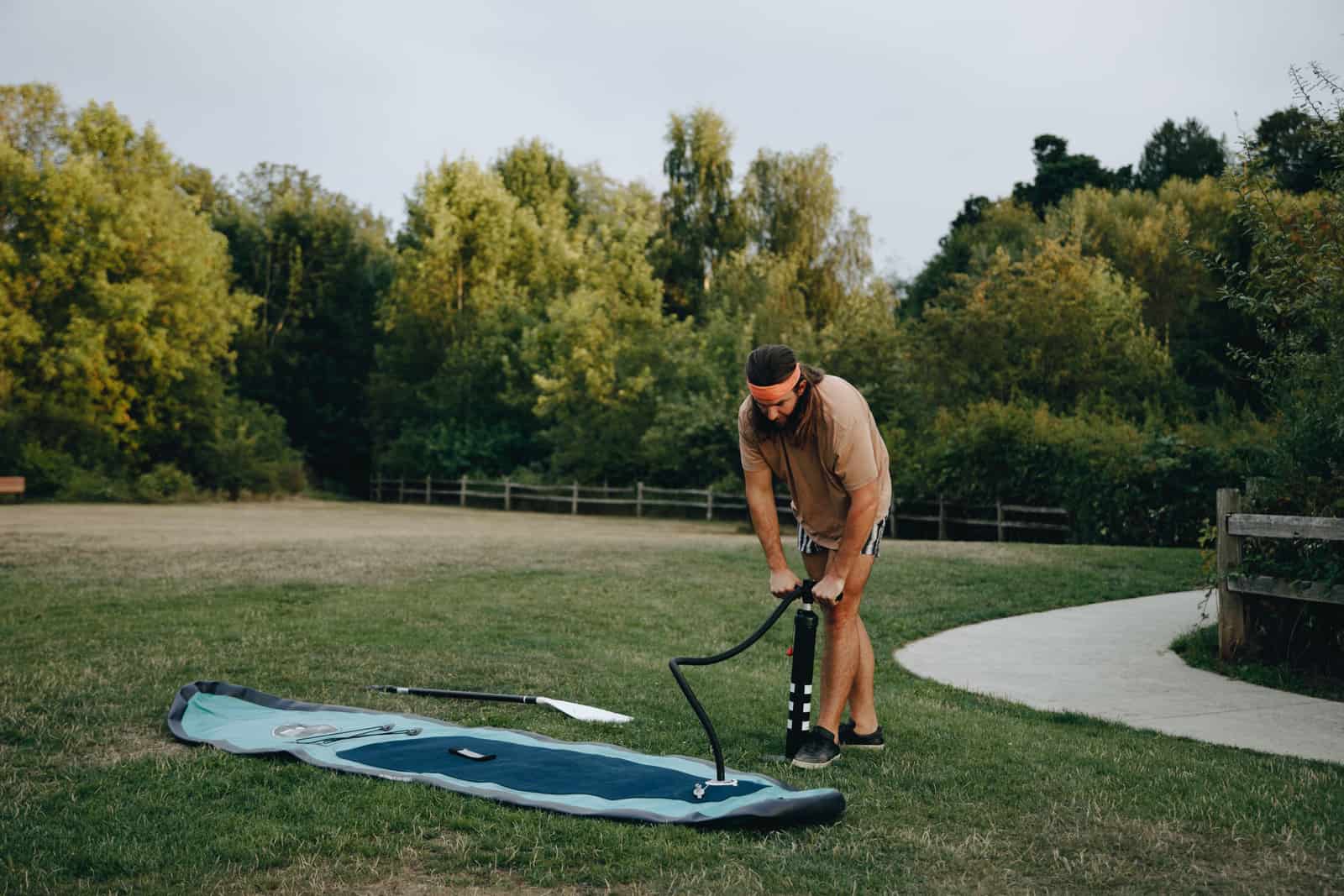
Of the eleven competitor buying guides measured during our research, two published an inflation time and none published a stroke count. It is the question every buyer asks and the number nobody supplies.
It is not hard to work out. Manufacturers publish board volume in liters and a target pressure in psi; hand pumps publish a cylinder volume and electric pumps publish flow rates. Everything else is division, and the whole model is below so you can check it.
- A 300 L board at 15 psi needs about 606 liters of free air -- roughly half to fill the shape, half to compress it.
- On a 2 L dual-action hand pump that is about 192 full strokes, of which around 82 are the hard single-action ones.
- On a two-stage electric pump published at 350 and 70 L/min it is about 5.2 minutes.
- Five of eight boards in our registry publish a volume. Zero of eight kayaks do.
The model, in full
To take an empty chamber of volume V liters to a gauge pressure of P psi, you need to push in enough atmospheric-pressure air to fill the shape and then enough again to compress it to pressure:
free air = V x (14.7 + P) / 14.7
For a 300 L board at 15 psi: 300 x 29.7 / 14.7 = 606 liters.
A dual-action hand pump moves air on both the push and the pull at low pressure, then has to be switched to single action when back pressure makes that impractical. So the stroke count splits:
- Phase one, 0 to 7 psi: the pump delivers two cylinders per full cycle. For a 2 L cylinder that is 4 L a stroke.
- Phase two, 7 psi to target: one cylinder per stroke, so 2 L.
For the 300 L board: phase one needs 443 liters, which is 111 strokes at 4 L. Phase two needs 163 liters, which is 82 strokes at 2 L. Total 193 strokes, and a third of them are the hard ones.
For a two-stage electric pump it is simply each phase's air divided by that phase's published flow rate.
Every board we can calculate
| Board | Volume (L) | Target psi | Free air (L) | Strokes | By hand | Two-stage electric |
|---|---|---|---|---|---|---|
| Red Paddle Co Compact 9'6 | 200 | 15 | 404 | 128 | 3.2 min | 3.5 min |
| GILI Air 10'6 | 225 | 15 | 455 | 144 | 3.6 min | 3.9 min |
| Atoll 11' | 238 | 15 | 481 | 153 | 3.8 min | 4.1 min |
| Bluefin Cruise 10'8 | 260 | 15 | 525 | 167 | 4.2 min | 4.5 min |
| NIXY Newport G5 | 300 | 15 | 606 | 192 | 4.8 min | 5.2 min |
What this model deliberately ignores
Every figure above is a planning estimate, and it is worth being precise about where it is soft:
- Air is treated as an ideal gas at constant temperature. Pumping warms it, so a board reading 15 psi while you work will read a little under once it cools.
- The chamber is treated as rigid at its final volume. Drop-stitch boards are very close to this. Round kayak tubes stretch as they come up to pressure, so their real figures would run higher.
- Hose volume, valve losses and the air lost each time you disconnect are all ignored.
- The 7 psi switchover is an assumption. Bravo's R.E.D. mechanism switches at 400 mbar, which is 5.8 psi, so the real split is a little more weighted toward the hard phase than the table shows.
- We have not timed any of this with a stopwatch, because we do not own any of this gear. These are calculations from published specifications, not measurements.
Why the kayak column is empty
Not one of the eight inflatable kayak manufacturers in our registry publishes a chamber volume. Without it, the calculation has no input, and there is no honest way to produce the number.
We could estimate it. Sea Eagle publishes a 10-inch tube diameter and a 12 ft 6 in hull, and a cylinder volume is easy arithmetic. But that estimate would need assumptions about how much the tubes taper at bow and stern, how much of the hull is floor chamber, and how the three chambers divide -- none of which is published, and any of which could move the answer by a third.
So the honest answer for kayaks is: much less than a board, because they run 1.1 to 6 psi rather than 15, and Sea Eagle's own claim for the SE370 is eight minutes. That is the only inflation figure any kayak manufacturer in our registry publishes.
- Electric versus hand pumpWhat these numbers mean for which pump to actually buy.
- Working pressure by modelThe target pressure that drives every calculation on this page.
- The lightest paddle boardsLower volume is less pumping. Here is the ranking.
Questions people actually ask
How long does it take to inflate a paddle board by hand?
How long does an electric pump take?
Why can't you calculate this for inflatable kayaks?
Does inflating to a lower pressure save much time?
Sources
Every specification on this page was read from one of these, on the date shown. Specs change between model years, so the date matters as much as the link.
- Red Paddle Co Compact 9'6 specifications, REI — read September 2, 2026
- Red Paddle Co Compact 9'6 package listing, Amazon — read September 2, 2026
- GILI Air inflatable paddle board package listing, Amazon — read September 2, 2026
- Atoll 11' specifications — read September 2, 2026
- Atoll 11' listing, Amazon — read September 2, 2026
- Bluefin Cruise 10'8 specifications — read September 2, 2026
- Bluefin Cruise 10'8 listing, Amazon — read September 2, 2026
- NIXY Newport all-around specifications — read September 2, 2026
- NIXY Newport G5 listing, Amazon — read September 2, 2026
- OutdoorMaster Shark II specifications — read September 2, 2026
- OutdoorMaster Shark 2 listing, Amazon — read September 2, 2026
- Bravo 4 ALU R.E.D. specifications, West Marine — read September 2, 2026
- Bravo 4 double action hand pump specifications, Inflatable Boat Parts — read September 2, 2026