The best inflatable kayaks for kids, and the four that cannot carry one
With a child aboard, capacity stops being the number that decides it. Seats, beam and a firm floor do -- and one federal rule applies before any of them.
By Scooter M. · Published September 26, 2026 · Last updated September 26, 2026
DisclosureSome links on this page are Amazon Associates links. If you buy through one we earn a commission at no extra cost to you. It does not change what we recommend or the order we recommend it in -- here is how we rank, and here is how the site is funded.
Search for a kayak for your kids and you get lists of adult boats with the word "family" added. So let us start with the thing those lists leave out: none of the eight inflatable kayaks we hold specifications for is a children's kayak. Not one manufacturer in this registry publishes a minimum age, a child weight rating, or a child-specific seat. What you are actually choosing is an adult boat with room for a child in it.
That reframing changes which number matters. Our camping and dog roundups both rank on payload, because a loaded kit or a large dog eats a rating. A child does not. A child adds less weight than any of these boats has spare, so capacity stops being the binding constraint and two other things take over: whether there is a seat for them at all, and how much the boat cares when they move.
One rule applies before any of that, and it is not a preference.
The short version
Federal law: no recreational vessel may be operated under way with a child under 13 aboard unless that child is wearing a Coast Guard-approved PFD. A kayak has no enclosed cabin, so the exception does not apply.
Four of the eight kayaks we cover are single-seat boats. A child cannot come in a PackLite, an AdvancedFrame, a Chelan 120 or a QuikPak K1, whatever the rating says.
Among the four that can, beam is the deciding figure: both Intex tandems are 36 in, the Driftsun Voyager 2 is 35 in, the Sea Eagle SE370 is 34 in.
Capacity is not the constraint here. The highest-rated boat in the registry is also the narrowest tandem and the softest hull, so it does not win this page.
The law comes first, and it is not ambiguous
33 CFR 175.15(c): no person may operate a recreational vessel under way with any child under 13 years old aboard unless each such child is either wearing an appropriate PFD approved by the Coast Guard, or below decks or in an enclosed cabin. An inflatable kayak has no below decks and no enclosed cabin, so on the boats on this page the second option does not exist. The child wears the PFD.
Two details worth knowing. The duty sits with the person operating the vessel, not with the child or the child's parent, and paragraph (a) of the same section separately requires a wearable PFD on board for each person -- so a child-sized one, fitted to that child, rather than a spare adult jacket. States can set their own requirements on their own waters, and some use a different age threshold, so check your state's rule as well as the federal one.
We are not going to recommend specific PFDs here, because we hold no specifications for them and have tested none. What we will say is that this is the one purchase on the trip that is not optional.
Half this category cannot carry a child at all
Seat count is the first filter and it removes four of the eight boats outright. It is also the figure most roundups skip, because rated capacity sounds like it covers the same ground and does not: the Sevylor QuikPak K1 is rated to 400 lb and has exactly one seat, so those 400 lb are all yours.
Seats, beam and working pressure across the eight kayaks
Model
Seats
Beam
Hull length
Working psi
Sea Eagle SE370
3
34 in
150 in
1.1
Intex Excursion Pro K2
2
36 in
151 in
Not published
Intex Explorer K2
2
36 in
123 in
Not published
Driftsun Voyager 2
2
35 in
120 in
2
Sevylor Quikpak K1
1
36 in
103 in
Not published
Advanced Elements PackLite
1
35 in
94 in
2
Advanced Elements AdvancedFrame
1
32 in
125 in
2
Aquaglide Chelan 120
1
32.5 in
135 in
3
Beam and hull length are the manufacturers' published dimensions, converted to inches so they compare. Seat count is the manufacturer's model designation. A blank working pressure means the manufacturer publishes no figure -- we do not estimate one.
Why capacity is the wrong number here
Every other payload page on this site works the same arithmetic: take the rating, take two thirds of it as a working load, subtract the people, and see what is left. That calculation is decisive when the thing you are adding is heavy. A child is not heavy relative to these ratings -- the four multi-seat boats are rated from 400 lb to 650 lb, and an adult plus a child does not come close to two thirds of any of them.
So the capacity column, which sorts our other roundups, sorts nothing here. What it does instead is mislead: it makes the 650 lb Sea Eagle SE370 look like the obvious answer when the two Intex boats are wider and firmer, and it makes the 400 lb single-seat Sevylor look like a candidate when it has no passenger seat at all. If you want the payload version of this question, that is what the weight limits guide is for.
Beam is what a moving passenger tests
A child in a kayak leans over the side, changes their mind about where to sit, and reaches for things in the water. Beam is the published figure that speaks to that most directly: a wider hull needs more weight shifted further before it rolls. Across the four multi-seat boats the spread is narrow but real -- 36 in on both Intex tandems, 35 in on the Driftsun Voyager 2, 34 in on the Sea Eagle SE370.
Length matters alongside it, because a short boat pivots when weight moves toward one end. The Excursion Pro K2 is the longest hull we cover at 12 ft 7 in and the widest at 36 in, which is why it heads this page. The Explorer K2 shares the beam but gives up 2 ft 4 in of length. Our length-to-beam ratios put the same hulls on a single axis if you want to see how the trade runs.
What beam does not capture is rocker, hull cross-section or seat position, and none of these manufacturers publishes any of those. Treat it as the best published proxy for stability rather than a measurement of it.
The floor a child stands on
Working pressure is the other half of how a boat feels with a child aboard, and it is where the registry is thinnest. The Aquaglide Chelan 120 publishes 3 psi, the AdvancedFrame, the PackLite and the Driftsun Voyager 2 publish 2 psi, and the Sea Eagle SE370 publishes 1.1 psi. Both Intex tandems and the Sevylor publish nothing at all.
The SE370's 1.1 psi is the honest cost of its capacity -- it carries 650 lb because it is a big low-pressure tube boat -- but a soft floor is exactly what a child who kneels or stands tests hardest. That the two boats ahead of it publish no pressure figure at all is a genuine caveat on this page rather than a point in their favor, and the pressure chart has every published figure we hold.
What none of these publishes
No manufacturer in this registry publishes a minimum age, a child weight rating, or a recommended child seating position. We are not going to fill those gaps with numbers of our own. There is no child-weight-by-age figure anywhere on this site, for the same reason there is no breed weight on the dog roundup: we have no source for one we would be willing to publish, and a figure invented for a page about children is the last place guesswork belongs.
What the specifications do support is everything above -- seats, beam, length and pressure, each one a published figure or a conversion of one. Where a manufacturer is silent, the table says so.
If the plan is for the child to paddle their own boat
This page ranks boats for an adult paddling with a child aboard. A child paddling solo is a different question, and the registry answers it badly: the four single-seat boats are adult kayaks, and the only one a small child could carry is the Advanced Elements PackLite at 4 lb of hull and 7 lb as a complete system. That same boat has the lowest capacity we list at 250 lb and, being single-seat, leaves no way for an adult to be in the boat too.
We are not going to turn that into a recommendation. It is the honest state of the data: nothing in this registry is designed for a child to paddle alone, and we would rather say so than rank eight adult boats against a use none of them was built for. The lightest inflatable kayaks page has the full carry-weight picture if that is the constraint you are solving.
Where you can buy each of these
All three ranked picks -- the Intex Excursion Pro K2, the Sea Eagle SE370 and the Intex Explorer K2 -- have live Amazon listings, so their buy links go to the product and the price shown is the one the pipeline read. The Sevylor QuikPak K1 does too, though this page is telling you not to buy it for this purpose.
The Driftsun Voyager 2 is in the table above and is deliberately unranked. It has 35 in of beam, two seats and a published 2 psi, which would otherwise put it in contention. On 26 September 2026 its Amazon listing returned "Currently unavailable", and on 23 September it was also out of stock at Target and Walmart, backordered at Sherper's, and absent from Driftsun's own inflatable kayak listing. Its specifications stand; we will not rank a boat we cannot find for sale.
The kayaks for paddling with kids, ranked
Ranked on seat count first, then beam and hull length, with published working pressure breaking the close calls. Every figure is a manufacturer's published specification or a conversion of one, the PFD requirement is quoted from the federal regulation, and we have not paddled any of it.
Ranked on beam. Tap any row to jump to the full write-up.
#
Product
Best for
Beam
Price
1
Best inflatable kayak for paddling with a childIntex Excursion Pro K2Forty-eight pounds is past the 50 lb checked-bag line once you add a bag, so this one drives rather than flies.
#ad Buy links are tagged Amazon Associates links. We earn a commission at no cost to you and it never changes the order.
The picks in full
#1 · Best inflatable kayak for paddling with a child
Intex Excursion Pro K2
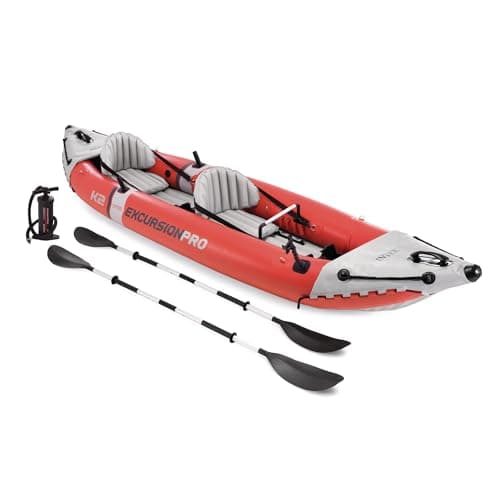
Three-ply PVC over a polyester core, 12 ft 7 in long, 400 lb capacity, and 48 lb of it. The most substantial boat Intex makes and by some distance the heaviest thing in this registry.
Thirty-six inches of beam is the widest hull we cover, and 12 ft 7 in is the longest. Those are the two figures that matter with a passenger who leans over the side to look at something, because width resists the roll and length keeps the boat from spinning when the weight moves. The 400 lb rating is far more than an adult and a child will ever ask of it, which is the point: capacity is not the binding constraint here, so you can buy the hull instead of the number. The cons are real. At 48.14 lb it is the heaviest boat in the registry, and you will be carrying it while also managing a child. It has two seats, so an adult and one child fills it -- there is no room for a second kid. And Intex publishes neither a working pressure nor a chamber count, so how firm it should be and what happens after a puncture are both unstated.
The trade-off
Forty-eight pounds is past the 50 lb checked-bag line once you add a bag, so this one drives rather than flies. Intex again publishes no packed size and no working pressure.
#ad We earn a commission if you buy through this link, at no extra cost to you. It never changes the ranking. How this site is funded. Prices checked September 27, 2026.
Intex Excursion Pro K2 published specifications
Weight (hull or board)
48.14 lb
Weight (full system)
Not published
Packed size
Not published
Packed linear inches
Not published
Inflated
12 ft 7 in x 36 in
Capacity
400 lb
Working pressure
Not published
Floor pressure
Not published
Volume
Not published
Material
Three-ply PVC vinyl laminate with a polyester core
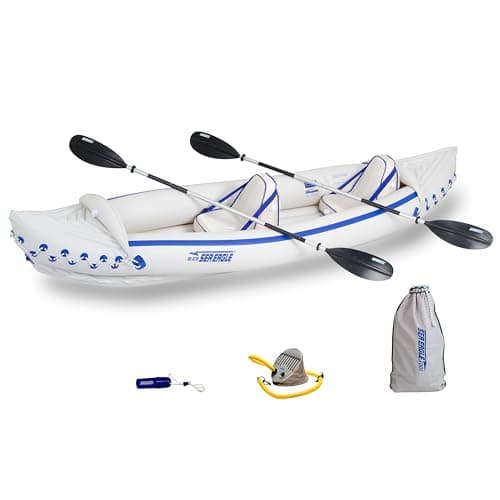
Twelve and a half feet of boat, 650 lb of capacity, 32 lb of hull, and it runs at 1.1 psi -- the lowest working pressure of anything here, which is why it is also one of the quickest to pump.
The only boat here with three seating positions, and 650 lb of rated capacity to go with them, so two adults and a child is within both the seat count and the rating with a large margin. Twelve feet six inches of hull gives a child somewhere to actually be rather than wedged between knees. Two honest cons, and the first one is the reason it is not ranked first: at 2 ft 10 in it is the narrowest of the four multi-seat boats, 2 in tighter than both Intex hulls. And at 1.1 psi it is the softest hull in this registry by a distance, so the floor gives under a child who stands up or kneels -- the boat that wins our payload pages does not win this one, because a child weighs very little and moves a lot.
The trade-off
Low pressure means a soft hull. It is forgiving and it is slow. The packed bag is 31 x 19 x 8 inches -- 58 linear inches, so it checks, but it is a bulky thing to carry through an airport.
#ad We earn a commission if you buy through this link, at no extra cost to you. It never changes the ranking. How this site is funded. Prices checked September 27, 2026.
Sea Eagle SE370 published specifications
Weight (hull or board)
32 lb
Weight (full system)
Not published
Packed size
31 x 19 x 8 in
Packed linear inches
58 in
Inflated
12 ft 6 in x 2 ft 10 in
Capacity
650 lb
Working pressure
1.1 psi
Floor pressure
Not published
Volume
Not published
Material
38 mil Polykrylar (K80 PVC)
Chambers
3
Valves
Five one-way air valves
Warranty
Not published
Computed · airline check
58 linear inches and 32 lb. Clears the 62-inch and 50 lb economy checked-bag limits.
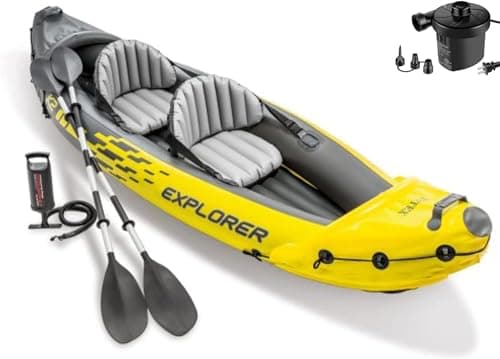
The cheapest way into a two-person inflatable, and the spec sheet is the shortest here: Intex publishes an inflated size, a weight and a capacity, and nothing a travel buyer can plan around.
The same 36 in beam as the Excursion Pro and the same 400 lb rating, on a hull that is 2 ft 4 in shorter and 11 lb lighter to carry. For short trips on flat water with one child aboard, the shorter boat is easier to manage at the put-in and gives up little that matters at kid pace. The cons follow from the same numbers: 10 ft 3 in is the shortest of the multi-seat boats, so it turns more readily than it holds a line, and a child shifting weight will move it more than it moves the Excursion Pro. Intex publishes no working pressure and no chamber count for this one either, and its skin is a rugged vinyl rather than the three-ply laminate of the Excursion Pro.
The trade-off
No published packed size and no published working pressure. You are buying 37 lb of vinyl on trust, and you will not know whether it fits your checked bag until it arrives.
#ad We earn a commission if you buy through this link, at no extra cost to you. It never changes the ranking. How this site is funded. Prices checked September 27, 2026.
#4 · Skip this one -- there is nowhere for a child to sit
Sevylor Quikpak K1
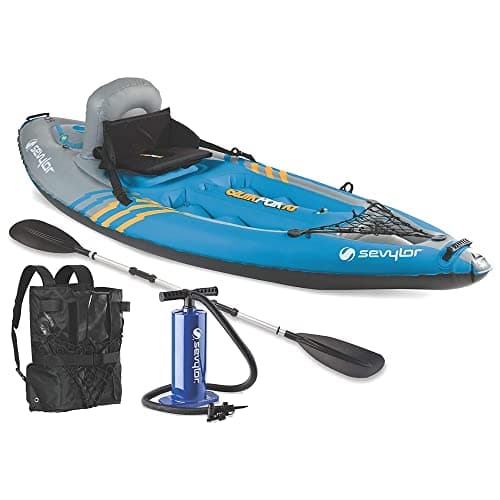
The bag is the seat and the seat is the bag. An 18 lb single that packs into a 31 x 9.25 x 17.5 inch backpack -- 57.75 linear inches, comfortably inside the checked-bag line, and you wear it to the water.
It is in this list to make a point that decides the purchase for a lot of people. The QuikPak K1 is a good solo boat -- 400 lb of rating on an 18 lb hull, with 3 ft of beam, and a backpack that unfolds into the seat -- but it is a single-seat boat, and a 400 lb rating on one seat does not make room for a passenger. The same applies to the Advanced Elements PackLite, the AdvancedFrame and the Aquaglide Chelan 120. Four of the eight kayaks we cover cannot take a child at all, and rated capacity is exactly the figure that hides it.
The trade-off
Sevylor publishes no working pressure for it. On a 21-gauge PVC boat that matters, because the difference between a hull that tracks and a hull that folds is a couple of tenths of a psi.
#ad We earn a commission if you buy through this link, at no extra cost to you. It never changes the ranking. How this site is funded. Prices checked September 27, 2026.
Sevylor Quikpak K1 published specifications
Weight (hull or board)
18 lb
Weight (full system)
Not published
Packed size
31 x 9.25 x 17.5 in
Packed linear inches
57.8 in
Inflated
8 ft 7 in x 3 ft
Capacity
400 lb
Working pressure
Not published
Floor pressure
Not published
Volume
Not published
Material
21-gauge PVC with a tarpaulin bottom
Chambers
Not published
Valves
Not published
Warranty
Not published
Computed · airline check
57.8 linear inches and 18 lb. Clears the 62-inch and 50 lb economy checked-bag limits.
For paddling with a child, the Intex Excursion Pro K2: it has the widest beam we cover at 36 in and the longest hull at 12 ft 7 in, which are the two figures that matter when a passenger shifts their weight. If there are two adults and a child, the Sea Eagle SE370 is the only boat here with three seating positions. Note that none of these is a children's kayak -- they are adult boats that have room for a child.
Do children have to wear a life jacket in a kayak?+
Under federal law, yes. 33 CFR 175.15(c) says no person may operate a recreational vessel under way with any child under 13 aboard unless each such child is wearing a Coast Guard-approved PFD, or is below decks or in an enclosed cabin. An inflatable kayak has neither, so on a kayak the exception does not exist and the PFD is required. Individual states can set their own rules, so check your state's as well. The duty falls on the person operating the boat.
What size inflatable kayak do I need for an adult and a child?+
Start with seats rather than size. Four of the eight kayaks we cover are single-seat boats, so they are out regardless of how much they are rated to carry. Among the rest, beam decides how much a moving passenger matters: both Intex tandems are 36 in, the Driftsun Voyager 2 is 35 in and the Sea Eagle SE370 is 34 in. Rated capacity is rarely the constraint, because a child adds far less weight than these boats have spare.
At what age can a child paddle their own inflatable kayak?+
We are not going to publish an age, because we have no source for one we would stand behind, and no manufacturer in this registry publishes a minimum age or a child weight rating either. What we can tell you is what the specifications say: the lightest boat we cover is the Advanced Elements PackLite at 4 lb of hull and 7 lb as a complete system, which is the only one in the registry a small child could carry. It is also rated to 250 lb, the lowest here, and it is a single-seat boat -- so an adult cannot ride along to supervise.
Are inflatable kayaks stable enough for children?+
We have not paddled any of these, so we will only report the published figures that bear on it. Beam runs from 32 in to 36 in across the eight boats, and working pressure from 1.1 psi to 3 psi where it is published at all -- both Intex tandems and the Sevylor publish no pressure figure. Wider and firmer resists a passenger's movement better, which is why the ranking here follows beam rather than the capacity ratings that decide our other roundups.
Units we claim to have tested: 0
Everyone in this category says they tested twenty boats. We have not tested any, and we say so. What we did instead: pulled the published specifications and the owner's manuals, computed the pump load and the packed volume for every model that publishes enough to compute them, checked the packed sizes against the airline limits you will actually meet, and cited every page we read. The full method.
Sources
Every specification on this page was read from one of these, on the date shown. Specs change between model years, so the date matters as much as the link.