Skip to content
Stroke & Stern

Are inflatable kayaks worth it? It depends which buyer you are

The honest answer is not a verdict on the category. It is a question about your car, your storage, the water you paddle and how much you weigh.

By Scooter M. · Published September 27, 2026 · Last updated September 27, 2026

Kayaks lined up on a lake shore under a cloudy sky
Disclosure Some links on this page are Amazon Associates links. If you buy through one we earn a commission at no extra cost to you. It does not change what we recommend or the order we recommend it in -- here is how we rank, and here is how the site is funded.

"Are they worth it" is almost never a question about the boats. Nobody asking it wants a lecture on drop-stitch; they want to know whether they will regret the purchase. That makes it a question about the buyer, and the useful answer sorts people rather than scoring products.

So here is the shape of it. An inflatable kayak wins everything that happens before and after the paddling -- storage, transport, lifting, travel -- and loses on the water to a rigid hull of the same length. Whether that is a good trade depends entirely on which of those two halves is currently stopping you from paddling.

For most people it is the first half, which is why the honest answer is usually yes. For three kinds of buyer it is not, and those three are worth naming before any recommendation.

The short version
  • The category's real product is storage and transport, not paddling. A boat that lives in a closet gets used more than one that needs a garage and a roof rack.
  • It is genuinely not worth it if you already have somewhere to keep a rigid boat and paddle from the same place every week.
  • It is not worth it for moving water. These are flatwater boats and using one in rapids is how people get hurt.
  • It is not worth it at the budget end if you weigh much over 200 lb -- the 300 lb boats cap out at a 180 lb paddler once kit is aboard.

What we judged this on

Not which boat is best -- the rest of this site does that. This page asks a narrower question: for a given buyer, does buying any of these beat buying nothing, or beat buying rigid. The three inputs are storage and transport reality, the water you actually paddle, and your own weight against the rating. Everything below follows from those.

We have not paddled any of these boats, and every figure here is a manufacturer's published specification or arithmetic on one. Where we say a boat will disappoint somebody, that is a conclusion from published numbers rather than a field report.

The case for, in one sentence and then properly

The case is that the best kayak is the one you actually use, and use is decided by friction. A rigid 12 ft boat needs a place to live, a rack to travel, and usually a second person to get it onto a car. An inflatable of the same length is a bag in a closet and a lift any adult can do alone. That difference does not show up on a spec sheet and it decides how many times a year the boat gets wet.

The second half of the case is capacity per dollar. The Sea Eagle SE370 is rated to 650 lb on a 32 lb hull, which in the rigid world means a boat that is a genuine logistical project. Here it is a bag. For families, for paddlers with a dog, and for anyone heavier than the category average, inflatables are not a compromise at all -- they are the only affordable answer.

The three buyers who should not

One: you already have the space. If you have a garage, a rack and somewhere to store a rigid boat ready to go, and you paddle the same water most weeks, the inflatable's advantage evaporates and its cost stays. You pay that cost twice per outing, in pumping at the start and drying and rolling at the end. Our inflation-time guide has the real numbers on the first half of that.

Two: you want moving water. Every boat in this registry is a flatwater design. Using one in rapids is how people get hurt, and no amount of spec-sheet reading changes it. We say so at greater length on the whitewater page, which exists mostly to talk people out of it.

Three: you are a heavier paddler shopping at the cheap end. The 300 lb boats in this registry support a 180 lb paddler once a paddle, PFD, water and dry bag are aboard, and the 250 lb boat supports 147 lb. A 220 lb paddler who buys one of those has bought a boat that floats them and sits too deep to enjoy. The heavier-paddler page works the ceiling out for all eight.

What you are actually giving up on the water

It is worth being concrete rather than diplomatic. A pressurized tube cannot hold the fine entry a rigid bow does, so an inflatable of a given length tracks less well and turns more readily than a hardshell of the same length. You feel it most in wind and on any crossing longer than a few hundred yards.

Two things narrow the gap and neither closes it. Length helps -- the 12 ft 7 in Intex Excursion Pro K2 behaves far more like a boat than an 8 ft 7 in solo does. Structure helps more: the Advanced Elements AdvancedFrame puts aluminum ribs in the bow and stern precisely to buy back some of what air gives away. If this is the part you care about most, the inflatable versus hardshell comparison is the head-to-head rather than this page.

The cost nobody puts in the review

A hardshell is carried to the water and paddled. An inflatable is unrolled, pumped, seated, paddled, then emptied, dried and rolled before it can go back in the bag. That last step is the one people skip, and a boat that is packed away damp is a boat that grows mildew and fails early.

None of that is an argument against the category. It is an argument for being honest about the routine before you buy, because the buyers who end up disappointed are almost never the ones who chose the wrong model -- they are the ones who did not price in the twenty minutes at each end.

What the category does not tell you

One number is missing everywhere and it is the one that would settle the durability half of this question: not a single kayak in this registry publishes a warranty term. Four of the eight do not publish a chamber count either. That is the category norm rather than a scandal, and it means the answer to "will this last" is being carried by brand reputation instead of a published commitment. We rank what they do publish on the most-durable page.

Where you can buy each of these

The Sevylor QuikPak K1, the Sea Eagle SE370 and the Intex Excursion Pro K2 all have live Amazon listings, so those buy links go to the product at the price the pipeline read. The Advanced Elements AdvancedFrame has no current Amazon offer, so its link is a tagged search; it is stocked at B&H, Scuba.com, Air Kayaks and Confluence Outdoor, which is the manufacturer.

The strongest cases for an inflatable, ranked

Ranked by how completely each boat answers the question that brings people to this category in the first place, with the honest cost of each named. Every figure is a manufacturer's published specification or arithmetic done on one, and we have not paddled any of it.

Read next

Quick picks

Ranked on weight. Tap any row to jump to the full write-up.

#ProductBest forWeightPrice
1
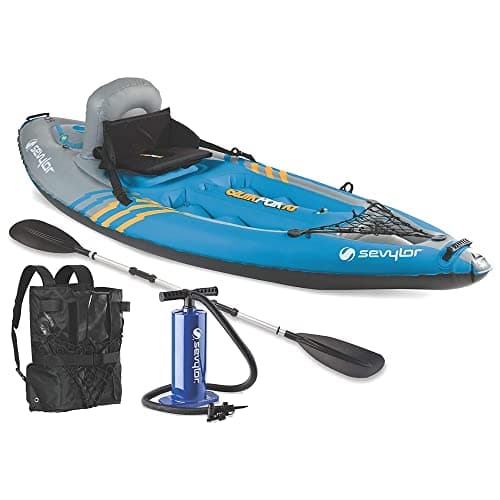
Sevylor Quikpak K1
Worth it if storage is the real problemSevylor Quikpak K1Sevylor publishes no working pressure for it.
Walking it to the water18 lb$225.51 · View on Amazon
2
Sea Eagle SE370
Worth it if you need capacity more than speedSea Eagle SE370Low pressure means a soft hull.
Two paddlers and a lot of gear32 lb$449.00 · View on Amazon
3
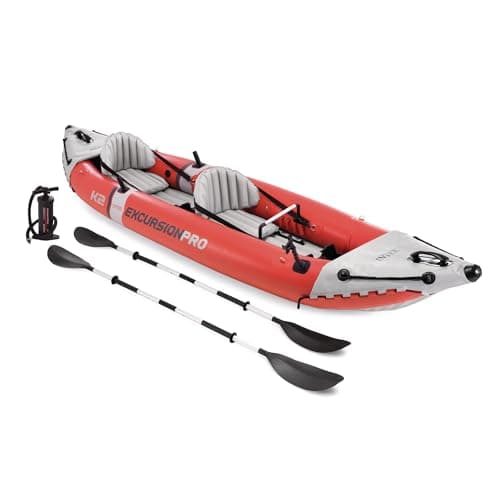
Intex Excursion Pro K2
Worth it as the cheapest way to put two people on waterIntex Excursion Pro K2Forty-eight pounds is past the 50 lb checked-bag line once you add a bag, so this one drives rather than flies.
Fishing from a stable platform48.14 lb$279.59 · View on Amazon
4
No photo
Worth it if you want it to paddle like a kayakAdvanced Elements AdvancedFrameThirty-six pounds folded to 30 x 17 x 10 inches.
Tracking on open water36 lbCheck price on Amazon

#ad Buy links are tagged Amazon Associates links. We earn a commission at no cost to you and it never changes the order.

The picks in full

Sevylor Quikpak K1
#1 · Worth it if storage is the real problem

Sevylor Quikpak K1

The bag is the seat and the seat is the bag. An 18 lb single that packs into a 31 x 9.25 x 17.5 inch backpack -- 57.75 linear inches, comfortably inside the checked-bag line, and you wear it to the water.

This is the clearest version of the category's whole argument. Eighteen pounds, a bag that is a backpack and unfolds into the seat, and a packed size of 57.75 linear inches -- which is to say it lives in a closet and travels in any car, including one that could never carry a hardshell. If the reason you do not own a kayak is that you have nowhere to put one, this boat removes the reason entirely and costs you very little to find out. The cons are honest: at 8 ft 7 in it is the shortest hull we cover and will not hold a line in wind, and Sevylor publishes neither a working pressure nor a chamber count, so two things you would want to know about a boat you are trusting are simply absent.

The trade-off

Sevylor publishes no working pressure for it. On a 21-gauge PVC boat that matters, because the difference between a hull that tracks and a hull that folds is a couple of tenths of a psi.

$225.51 · View on Amazon

#ad We earn a commission if you buy through this link, at no extra cost to you. It never changes the ranking. How this site is funded. Prices checked September 27, 2026.

Sevylor Quikpak K1 published specifications
Weight (hull or board)18 lb
Weight (full system)Not published
Packed size31 x 9.25 x 17.5 in
Packed linear inches57.8 in
Inflated8 ft 7 in x 3 ft
Capacity400 lb
Working pressureNot published
Floor pressureNot published
VolumeNot published
Material21-gauge PVC with a tarpaulin bottom
ChambersNot published
ValvesNot published
WarrantyNot published
Computed · airline check

57.8 linear inches and 18 lb. Clears the 62-inch and 50 lb economy checked-bag limits.

31 + 9.25 + 17.5 = 57.8 in

We have not paddled this one. Specifications above are the manufacturer's own, read on September 2, 2026 from Sevylor K1 QuikPak specifications, Coleman and Sevylor QuickPak K1 listing, Amazon. Full Sevylor Quikpak K1 write-up

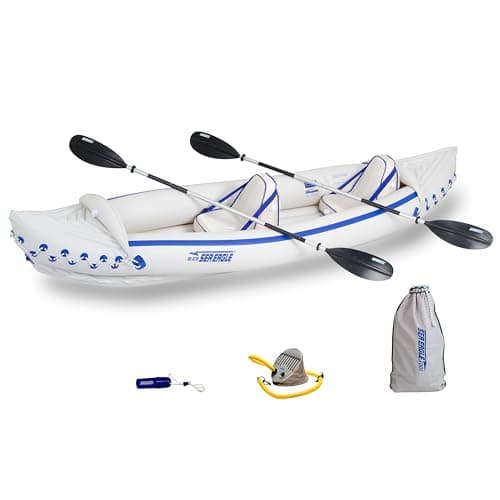
Sea Eagle SE370
#2 · Worth it if you need capacity more than speed

Sea Eagle SE370

Twelve and a half feet of boat, 650 lb of capacity, 32 lb of hull, and it runs at 1.1 psi -- the lowest working pressure of anything here, which is why it is also one of the quickest to pump.

Six hundred and fifty pounds of rated capacity on a 32 lb hull is a combination the rigid world does not offer at anything like this price -- a hardshell that carries three people is a roof-rack problem, a storage problem and a two-person lift. The SE370 is a bag. For a family, a paddler with a dog, or anyone over about 250 lb, this is the strongest case in the category and the arithmetic behind it is on our heavier-paddler page. The cons are the ones capacity buys: 1.1 psi is the softest hull we list, so it flexes more than a rigid boat or a high-pressure one, and at 2 ft 10 in it is narrower than five other boats here despite carrying the most.

The trade-off

Low pressure means a soft hull. It is forgiving and it is slow. The packed bag is 31 x 19 x 8 inches -- 58 linear inches, so it checks, but it is a bulky thing to carry through an airport.

$449.00 · View on Amazon

#ad We earn a commission if you buy through this link, at no extra cost to you. It never changes the ranking. How this site is funded. Prices checked September 27, 2026.

Sea Eagle SE370 published specifications
Weight (hull or board)32 lb
Weight (full system)Not published
Packed size31 x 19 x 8 in
Packed linear inches58 in
Inflated12 ft 6 in x 2 ft 10 in
Capacity650 lb
Working pressure1.1 psi
Floor pressureNot published
VolumeNot published
Material38 mil Polykrylar (K80 PVC)
Chambers3
ValvesFive one-way air valves
WarrantyNot published
Computed · airline check

58 linear inches and 32 lb. Clears the 62-inch and 50 lb economy checked-bag limits.

31 + 19 + 8 = 58 in

We have not paddled this one. Specifications above are the manufacturer's own, read on September 2, 2026 from Sea Eagle SE370 specifications and Sea Eagle SE370 Pro package listing, Amazon. Full Sea Eagle SE370 write-up

Intex Excursion Pro K2
#3 · Worth it as the cheapest way to put two people on water

Intex Excursion Pro K2

Three-ply PVC over a polyester core, 12 ft 7 in long, 400 lb capacity, and 48 lb of it. The most substantial boat Intex makes and by some distance the heaviest thing in this registry.

Twelve feet seven inches, two seats, a 400 lb rating and a three-ply laminate skin, at a price bracket where the rigid equivalent is a used boat and a roof rack. For a buyer whose question is really 'can I get two of us on a lake a few times a summer without rearranging my life', this is the answer, and it is a genuinely capable hull rather than a toy. The cons are real and they are about information as much as the boat: Intex publishes no chamber count, no working pressure and no warranty, so you are trusting the brand rather than checking it. At 48.14 lb it is also the heaviest thing in the registry to carry from the car.

The trade-off

Forty-eight pounds is past the 50 lb checked-bag line once you add a bag, so this one drives rather than flies. Intex again publishes no packed size and no working pressure.

$279.59 · View on Amazon

#ad We earn a commission if you buy through this link, at no extra cost to you. It never changes the ranking. How this site is funded. Prices checked September 27, 2026.

Intex Excursion Pro K2 published specifications
Weight (hull or board)48.14 lb
Weight (full system)Not published
Packed sizeNot published
Packed linear inchesNot published
Inflated12 ft 7 in x 36 in
Capacity400 lb
Working pressureNot published
Floor pressureNot published
VolumeNot published
MaterialThree-ply PVC vinyl laminate with a polyester core
ChambersNot published
ValvesNot published
WarrantyNot published

We have not paddled this one. Specifications above are the manufacturer's own, read on September 2, 2026 from Intex Excursion Pro K2 official specifications and Intex Excursion Pro K2 listing, Amazon. Full Intex Excursion Pro K2 write-up

No photoWe have no photograph of this exact model that we can honestly publish
#4 · Worth it if you want it to paddle like a kayak

Advanced Elements AdvancedFrame

Aluminum ribs in the bow and stern give it a defined shape that round inflatable tubes cannot, and it tracks like it. You pay for that in 36 lb and a folded package the size of a large duffel.

The most common disappointment in this category is that an inflatable does not track like a rigid boat, because pressurized tubes cannot hold a fine entry. The AdvancedFrame is the one boat here that partly answers that, with aluminum ribs in the bow and stern giving it a defined shape that air alone does not -- and seven air chambers, the best puncture margin we list. If your hesitation is that inflatables feel like rafts, this is the boat that tests the objection. The cons: 36 lb is heavy for a single-seat boat and undercuts the portability argument, the 300 lb rating caps it at a 180 lb paddler on our arithmetic, and there is no current Amazon offer, so the buy link is a tagged search.

The trade-off

Thirty-six pounds folded to 30 x 17 x 10 inches. That is 57 linear inches -- inside the checked-bag line on size, but you are within 14 lb of the weight limit before you have added a pump or a paddle.

Check price on Amazon

#ad We earn a commission if you buy through this link, at no extra cost to you. It never changes the ranking. How this site is funded. Prices checked September 27, 2026.

Advanced Elements AdvancedFrame published specifications
Weight (hull or board)36 lb
Weight (full system)Not published
Packed size30 x 17 x 10 in
Packed linear inches57 in
Inflated10 ft 5 in x 32 in
Capacity300 lb
Working pressure2 psi
Floor pressure1 psi
VolumeNot published
MaterialPVC tarpaulin with aluminum bow and stern ribs
Chambers7
ValvesTwistlok and military-style, 1 psi floor pressure-release valve
WarrantyNot published
Computed · airline check

57 linear inches and 36 lb. Clears the 62-inch and 50 lb economy checked-bag limits.

30 + 17 + 10 = 57 in

We have not paddled this one. Specifications above are the manufacturer's own, read on September 2, 2026 from Advanced Elements AdvancedFrame AE1012 owner's manual and AdvancedFrame AE1012-R specifications, B&H. Full Advanced Elements AdvancedFrame write-up

Questions people actually ask

Are inflatable kayaks worth it?
For most buyers, yes -- and the reason is storage and transport rather than paddling. An inflatable that lives in a closet and fits in any car gets used; a hardshell that needs a garage, a rack and a second person to lift often does not. The exceptions are real though: if you already have somewhere to keep a rigid boat and paddle from the same place every week, if you want moving water, or if you are shopping at the budget end and weigh more than about 200 lb, the honest answer is no.
Are inflatable kayaks any good, or are they toys?
The serious ones are genuinely good boats and the gap between the ends of the category is enormous. In our registry the range runs from a 4 lb ultralight to a 12 ft 7 in three-ply laminate tandem to a boat with aluminum ribs and seven air chambers. What separates them is mostly what the manufacturer will publish -- four of the eight kayaks we cover will not tell you how many air chambers the boat has, and not one publishes a warranty.
How long do inflatable kayaks last?
Longer than most buyers expect, and it depends far more on storage than on brand. The specifications that bear on it are chamber count, skin material and working pressure, which we rank across all eight boats on our most-durable page. The things that actually end them -- dragging a loaded hull over gravel, storing it inflated in direct sun, and repeated over-inflation -- are all handling rather than construction.
Is an inflatable kayak better than a hardshell?
Not on the water, and that is the trade. A rigid hull holds a finer entry and tracks better than pressurized fabric can, and no inflatable in this registry changes that. What an inflatable wins is everything either side of the paddling: it fits in a closet, travels in any car, needs no rack and no second person to lift. We compare the two properly on our inflatable versus hardshell page.
How long does an inflatable kayak take to set up?
Minutes rather than seconds, and it is the cost people most underestimate because it is paid at both ends of every outing. Pumping, fitting seats and then drying and rolling the boat before it goes back in the bag is real time, and a boat that goes away wet does not last. If you paddle from the same spot several times a week and have somewhere to keep a rigid boat ready to go, that repeated cost is the strongest argument against this whole category.
Units we claim to have tested: 0

Everyone in this category says they tested twenty boats. We have not tested any, and we say so. What we did instead: pulled the published specifications and the owner's manuals, computed the pump load and the packed volume for every model that publishes enough to compute them, checked the packed sizes against the airline limits you will actually meet, and cited every page we read. The full method.

Sources

Every specification on this page was read from one of these, on the date shown. Specs change between model years, so the date matters as much as the link.