The most durable inflatable kayaks, ranked on what is actually published
Every brand in this category claims toughness. Four of the eight will not tell you how many air chambers the boat has, and not one publishes a warranty.
By Scooter M. · Published September 27, 2026 · Last updated September 27, 2026
DisclosureSome links on this page are Amazon Associates links. If you buy through one we earn a commission at no extra cost to you. It does not change what we recommend or the order we recommend it in -- here is how we rank, and here is how the site is funded.
Durability is the claim every brand in this category makes and the one almost none of them supports with a figure. Read eight product pages and you will collect "rugged", "heavy-duty", "puncture-resistant" and "military-grade" without once being told how many air chambers the boat has or how thick its skin is.
There are exactly three durability specifications a manufacturer in this registry might publish: chamber count, skin material or thickness, and working pressure. This page ranks the eight kayaks we hold specifications for on those three, and treats a blank as what it is -- a question the manufacturer chose not to answer, which is itself information.
Our durability guide explains what each figure means and why it matters. This page names the boats.
The short version
Chamber count is the figure that decides a bad day, and four of the eight kayaks here publish no count at all.
The Advanced Elements AdvancedFrame publishes seven chambers. Three is the category norm.
Only two boats publish an actual skin thickness: the Sea Eagle SE370 at 38 mil and the Sevylor QuikPak K1 at 21-gauge. Everyone else uses adjectives.
Not one of the eight publishes a warranty. On the paddle board side of this site, several brands publish three and five year terms.
The three figures we ranked, and why these three
Chamber count comes first because it is the only one that changes the outcome of a failure rather than its likelihood. A boat with three independent chambers that loses one is a boat you paddle back to shore. A single-chamber boat that loses one is a swim. Nothing else on the spec sheet does that.
Skin comes second, and the problem is that it is usually described rather than measured. A thickness in mil or a gauge is checkable; a claim of "heavy-duty vinyl" is not. Where a manufacturer gives a number we use it, and where they give an adjective we print the adjective and say so.
Working pressure comes third and is the one most often confused with toughness. It is a rigidity figure. A firm hull flexes less, and less flex over several seasons is a real durability benefit, but a high-pressure boat with a thin skin is not tougher than a low-pressure boat with a thick one.
What each maker actually publishes
The published durability figures across all eight kayaks
Three-ply PVC vinyl laminate with a polyester core
Not published
None published
Intex Explorer K2
Not published
Rugged vinyl with an inflatable I-beam floor
Not published
None published
Sevylor Quikpak K1
Not published
21-gauge PVC with a tarpaulin bottom
Not published
None published
Every entry is the manufacturer's own published description or figure. 'Not published' means exactly that -- we do not estimate a chamber count or a pressure, and we do not convert an adjective into a number.
Seven chambers is the outlier, and it is the reason for the ranking
The Advanced Elements AdvancedFrame publishes seven air chambers. The Sea Eagle SE370, the Driftsun Voyager 2 and the PackLite publish three. Four boats publish nothing. That single spread is the most consequential thing in the table, because it is the difference between a hull with a large margin and hulls where the margin is unknown.
It is worth being precise about what seven chambers does and does not buy. It does not make the skin harder to cut. It means that when a chamber goes, a larger share of the boat is still holding air and still holding shape, which is what turns an incident into an inconvenience. On a solo boat, far from help, that is worth more than it sounds. The chambers guide has the full argument.
The two boats that publish a thickness
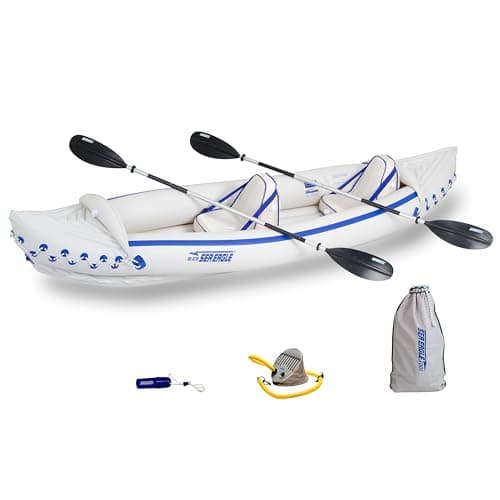
The Sea Eagle SE370 publishes 38 mil Polykrylar, which it also calls K80 PVC. The Sevylor QuikPak K1 publishes a 21-gauge PVC with a tarpaulin bottom. Those are the only two numbers of their kind in this registry, and the SE370's is the heavier skin by a clear margin.
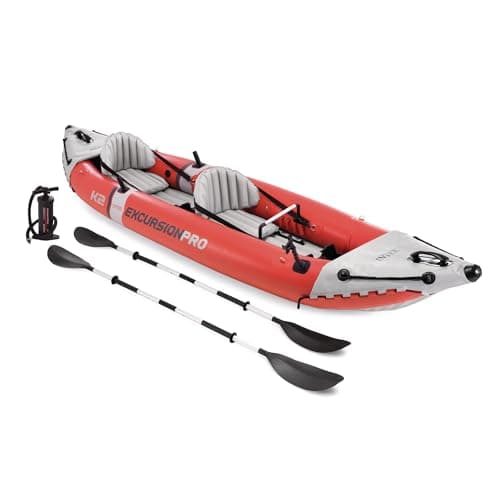
Everybody else describes. "Three-ply PVC vinyl laminate with a polyester core" on the Intex Excursion Pro K2 is a genuine construction description and tells you real things about layup; it is still not a thickness. "Rugged vinyl" on the Explorer K2 tells you almost nothing. "Duratex" on the Aquaglide Chelan 120 is a brand name for a fabric. We have not tested any of them, so where a maker declines to publish a number we leave it at their description rather than inventing a comparison. The materials themselves are covered in our materials guide.
The warranty column that is empty all the way down
Not one of these eight kayaks publishes a warranty term. We have left the column in the table precisely so you can see that, because it is the single clearest signal in this category and it is invisible if nobody shows it to you.
The contrast is instructive. Across on the paddle board side of this registry, NIXY publishes three years and Bluefin publishes five. Those brands have decided that a published term is worth making. In inflatable kayaks the norm is to say nothing, which means a warranty cannot be used to separate these boats -- and that the informal reputation of a brand is doing work that a published commitment would otherwise do.
What actually kills an inflatable kayak
We have not paddled any of these boats and we are not going to tell you how they behave against a rock. What we can say is what the specifications bear on. The failure modes this category is vulnerable to are abrasion from dragging a loaded boat over gravel, UV exposure from storing it inflated in the sun, and seam fatigue from repeated over-inflation -- and of those three, only the first is really a material property. The other two are how the boat is treated, which is why the repair guide matters more in this category than the brand on the side does.
Where you can buy each of these
The Sea Eagle SE370, both Intex tandems and the Sevylor QuikPak K1 have live Amazon listings, so those links go to the product at the price the pipeline read. The Advanced Elements AdvancedFrame and PackLite have no current Amazon offer, so their links are tagged searches; the AdvancedFrame is stocked at B&H, Scuba.com, Air Kayaks and Confluence Outdoor, which is the manufacturer.
The Driftsun Voyager 2 publishes three chambers and a reinforced PVC skin, which would place it mid-table on merit. It is in the table and deliberately unranked: on 27 September 2026 its Amazon listing returned "Currently unavailable", matching the same result on 23 and 26 September, when it was also out of stock at Target and Walmart and absent from Driftsun's own collection page.
The most durable inflatable kayaks, ranked
Ranked on chamber count first, then published skin, with working pressure breaking the close calls and a blank counted against the boat rather than ignored. Every figure is a manufacturer's published specification, and we have not paddled any of it.
Best of the boats that publish nothingIntex Excursion Pro K2Forty-eight pounds is past the 50 lb checked-bag line once you add a bag, so this one drives rather than flies.
#ad Buy links are tagged Amazon Associates links. We earn a commission at no cost to you and it never changes the order.
The picks in full
No photoWe have no photograph of this exact model that we can honestly publish
#1 · Most durable inflatable kayak
Advanced Elements AdvancedFrame
Aluminum ribs in the bow and stern give it a defined shape that round inflatable tubes cannot, and it tracks like it. You pay for that in 36 lb and a folded package the size of a large duffel.
Seven air chambers against a category where three is normal and four boats publish no figure at all. That is the specification that decides whether a puncture is an inconvenience or the end of the day, and nothing else we cover is close. The skin is PVC tarpaulin -- a heavier, more abrasion-tolerant cloth than the vinyl on the cheaper boats -- and the aluminum ribs in the bow and stern are structure rather than pressure, so the shape does not depend entirely on air. The cons are weight and ceiling: 36 lb is heavy for a single-seat boat, the 300 lb rating caps it at a 180 lb paddler on our arithmetic, and Advanced Elements publishes no warranty, which in this category is normal and still worth knowing. There is no current Amazon offer, so the buy link is a tagged search; it is stocked at B&H, Scuba.com, Air Kayaks and Confluence Outdoor.
The trade-off
Thirty-six pounds folded to 30 x 17 x 10 inches. That is 57 linear inches -- inside the checked-bag line on size, but you are within 14 lb of the weight limit before you have added a pump or a paddle.
#ad We earn a commission if you buy through this link, at no extra cost to you. It never changes the ranking. How this site is funded. Prices checked September 27, 2026.
Advanced Elements AdvancedFrame published specifications
Weight (hull or board)
36 lb
Weight (full system)
Not published
Packed size
30 x 17 x 10 in
Packed linear inches
57 in
Inflated
10 ft 5 in x 32 in
Capacity
300 lb
Working pressure
2 psi
Floor pressure
1 psi
Volume
Not published
Material
PVC tarpaulin with aluminum bow and stern ribs
Chambers
7
Valves
Twistlok and military-style, 1 psi floor pressure-release valve
Warranty
Not published
Computed · airline check
57 linear inches and 36 lb. Clears the 62-inch and 50 lb economy checked-bag limits.
Twelve and a half feet of boat, 650 lb of capacity, 32 lb of hull, and it runs at 1.1 psi -- the lowest working pressure of anything here, which is why it is also one of the quickest to pump.
Thirty-eight mil Polykrylar, which Sea Eagle calls K80 PVC, is one of only two actual thickness figures published anywhere in this registry -- everyone else describes their material in adjectives. Thirty-eight thousandths of an inch is a genuinely heavy skin, and it is paired with three chambers, which is the category norm rather than an outlier. It is also the boat most likely to survive being dragged up a gravel bank, which is how most inflatables actually die. The cons: three chambers is redundancy, not the seven the AdvancedFrame gives you, and at 1.1 psi this is the softest hull we list -- a low-pressure boat flexes more, and flex over years is its own kind of wear. No published warranty.
The trade-off
Low pressure means a soft hull. It is forgiving and it is slow. The packed bag is 31 x 19 x 8 inches -- 58 linear inches, so it checks, but it is a bulky thing to carry through an airport.
#ad We earn a commission if you buy through this link, at no extra cost to you. It never changes the ranking. How this site is funded. Prices checked September 27, 2026.
Sea Eagle SE370 published specifications
Weight (hull or board)
32 lb
Weight (full system)
Not published
Packed size
31 x 19 x 8 in
Packed linear inches
58 in
Inflated
12 ft 6 in x 2 ft 10 in
Capacity
650 lb
Working pressure
1.1 psi
Floor pressure
Not published
Volume
Not published
Material
38 mil Polykrylar (K80 PVC)
Chambers
3
Valves
Five one-way air valves
Warranty
Not published
Computed · airline check
58 linear inches and 32 lb. Clears the 62-inch and 50 lb economy checked-bag limits.
Three-ply PVC over a polyester core, 12 ft 7 in long, 400 lb capacity, and 48 lb of it. The most substantial boat Intex makes and by some distance the heaviest thing in this registry.
A three-ply PVC vinyl laminate with a polyester core is a real construction description and a step above the rugged vinyl of the cheaper Explorer K2, and at 12 ft 7 in on the longest hull we cover it is the most serious-feeling boat Intex makes. It is ranked third rather than higher for a reason that has nothing to do with the boat and everything to do with the buyer: Intex publishes no chamber count, no working pressure and no warranty, so on the three figures this page ranks, two are blank and the third is a description rather than a measurement. You are trusting the brand instead of checking it. At 48.14 lb it is also the heaviest hull here.
The trade-off
Forty-eight pounds is past the 50 lb checked-bag line once you add a bag, so this one drives rather than flies. Intex again publishes no packed size and no working pressure.
#ad We earn a commission if you buy through this link, at no extra cost to you. It never changes the ranking. How this site is funded. Prices checked September 27, 2026.
Intex Excursion Pro K2 published specifications
Weight (hull or board)
48.14 lb
Weight (full system)
Not published
Packed size
Not published
Packed linear inches
Not published
Inflated
12 ft 7 in x 36 in
Capacity
400 lb
Working pressure
Not published
Floor pressure
Not published
Volume
Not published
Material
Three-ply PVC vinyl laminate with a polyester core
No photoWe have no photograph of this exact model that we can honestly publish
#4 · The exception that proves the rule
Advanced Elements PackLite
A 4 lb kayak that rolls to 11 x 11 x 5 inches. Nothing else in the category is close on either number, and the compromises are exactly the ones you would expect.
Four pounds of fabric-reinforced polyurethane on a PVC-free polyester ripstop, with three chambers and a 2 psi working pressure -- and it is on this page as a caution rather than a recommendation. Ultralight materials buy their weight saving from somewhere, and here it is from skin thickness and from capacity: 250 lb rated is the lowest in the registry, which is a 147 lb paddler ceiling once kit is aboard. If your definition of durable is a boat you can drag over rock, this is the wrong one. If it is a boat light enough that you carry it around the hazard instead, it is the only answer in the category.
The trade-off
At 2 psi in the side tubes and 1 psi in the floor there is very little structure here. It is a boat for getting somewhere remote, not for a windy afternoon on open water.
#ad We earn a commission if you buy through this link, at no extra cost to you. It never changes the ranking. How this site is funded. Prices checked September 27, 2026.
Advanced Elements PackLite published specifications
The Advanced Elements AdvancedFrame, on the one durability figure most of this category will actually publish: it has seven air chambers where three is the norm, so losing one is a manageable problem rather than a swim. It also uses a PVC tarpaulin skin and aluminum ribs in the bow and stern. The Sea Eagle SE370 is the other serious answer -- it publishes a 38 mil skin thickness, which almost nobody else does.
How many air chambers should an inflatable kayak have?+
More than one, and the useful question is whether the manufacturer will tell you. In our registry the Advanced Elements AdvancedFrame publishes seven, the Sea Eagle SE370, the Driftsun Voyager 2 and the Advanced Elements PackLite publish three, and four boats -- both Intex tandems, the Sevylor QuikPak K1 and the Aquaglide Chelan 120 -- publish no figure at all. A boat with three independent chambers stays afloat after one fails. A boat that does not state a count has not answered the question.
Do inflatable kayaks puncture easily?+
We have not paddled any of these, so we will not tell you how they behave on rock. What the specifications support is this: the skins in this registry range from a 21-gauge PVC to a 38 mil Polykrylar to a PVC tarpaulin over aluminum ribs, and only two of the eight publish an actual thickness. Most punctures in this category come from dragging a loaded boat over gravel rather than from anything on the water, which is an argument for a heavy skin and for carrying rather than dragging.
Do inflatable kayaks come with a warranty?+
Not one of the eight kayaks we hold specifications for publishes a warranty term. That is worth stating plainly because it is unusual -- on the paddle board side of this site several brands publish two, three and five year terms. In kayaks the category norm is silence, so a warranty is not a figure you can use to separate these boats, and we have left the column in the table below showing exactly that.
Does higher pressure mean a more durable inflatable kayak?+
Not directly. Working pressure tells you how rigid the hull is when correctly inflated, not how tough the skin is. In this registry the Aquaglide Chelan 120 runs the highest at 3 psi and the Sea Eagle SE370 the lowest at 1.1 psi, and the SE370 has the thicker published skin of the two. A firmer boat paddles better and flexes less over time; a thicker boat survives abrasion better. They are different properties and this category does not rank them in the same order.
Units we claim to have tested: 0
Everyone in this category says they tested twenty boats. We have not tested any, and we say so. What we did instead: pulled the published specifications and the owner's manuals, computed the pump load and the packed volume for every model that publishes enough to compute them, checked the packed sizes against the airline limits you will actually meet, and cited every page we read. The full method.
Sources
Every specification on this page was read from one of these, on the date shown. Specs change between model years, so the date matters as much as the link.