The best inflatable kayaks for bigger and heavier paddlers
Every other page asks what a boat has left for cargo. This one asks how much paddler it takes in the first place, which is a figure no manufacturer prints.
By Scooter M. · Published September 27, 2026 · Last updated September 27, 2026
DisclosureSome links on this page are Amazon Associates links. If you buy through one we earn a commission at no extra cost to you. It does not change what we recommend or the order we recommend it in -- here is how we rank, and here is how the site is funded.
Ask what an inflatable kayak holds and every manufacturer answers the same way: a single rated capacity, covering the paddler and everything else aboard at once. That is a useful number for a shopper who weighs 160 lb and a nearly useless one for a shopper who weighs 260 lb, because it never separates the person from the cargo.
So this page solves it backwards. Take each boat's rated capacity, work it to the two-thirds load we plan to everywhere, subtract 20 lb for a paddle, a PFD, water and a dry bag, and what is left is the heaviest paddler that boat actually supports. No manufacturer publishes that figure. It is the one a bigger paddler most needs.
The answer is more lopsided than the capacity column suggests. One boat supports a 413 lb paddler. Three cap out at 180 lb or less.
The short version
The Sea Eagle SE370 supports a 413 lb paddler on our arithmetic. Nothing else we cover comes within 160 lb of it.
The three 400 lb boats -- both Intex tandems and the Sevylor QuikPak K1 -- all land on the same 247 lb paddler ceiling.
The 300 lb boats cap out at a 180 lb paddler, and the Advanced Elements PackLite at 147 lb. Those are good boats rated for a lighter person.
Capacity and stability do not rank together: the boat with the most capacity is one of the narrowest hulls here at 2 ft 10 in.
What we judged these on, and why not just capacity
Rated capacity is where a manufacturer stops making claims. It is not a comfortable working load, and none of these brands publishes how they arrived at it or what the boat does as you approach it. Loading any boat to its printed maximum puts the hull deeper in the water, which increases wetted area, slows it down and makes it wetter to sit in -- so we plan to two thirds of the rating and say so every time we use it.
The second judgment is beam, which is where initial stability comes from. A heavier paddler sits lower in any hull, and a wider hull resists the roll that follows. Beam and capacity turn out not to rank in the same order in this registry, which is the most useful thing on this page after the ceiling figure itself.
The heaviest paddler each boat supports
Paddler ceiling at a two-thirds working load with 20 lb of kit aboard
Model
Rated capacity (lb)
Two-thirds working load (lb)
Heaviest paddler supported
Beam
Sea Eagle SE370
650
433
413 lb
2 ft 10 in
Driftsun Voyager 2
450
300
280 lb
35 in
Intex Excursion Pro K2
400
267
247 lb
36 in
Intex Explorer K2
400
267
247 lb
3 ft
Sevylor Quikpak K1
400
267
247 lb
3 ft
Advanced Elements AdvancedFrame
300
200
180 lb
32 in
Aquaglide Chelan 120
300
200
180 lb
32.5 in
Advanced Elements PackLite
250
167
147 lb
35 in
Rated capacity and beam are the manufacturers' published figures. The working load and the paddler ceiling are our arithmetic and our stated convention: two thirds of the rating, less 20 lb of paddle, PFD, water and dry bag. That kit weight is an input rather than a claim -- substitute your own and every figure moves by the difference.
Why one boat runs away with it
The SE370 is rated to 650 lb because Sea Eagle sells it as a three-person boat, and a solo paddler inherits all of that. Four hundred and thirteen pounds of paddler ceiling is not a figure anybody needs; what it means in practice is that a 250 lb or 280 lb paddler is nowhere near the line, and being nowhere near the line is the whole point. Every other boat on this page asks a heavier paddler to think about the margin. This one does not.
It earns that with volume rather than cleverness -- 12 ft 6 in of hull at 1.1 psi, the lowest working pressure we list. That is also its cost, and it is worth being plain about: a low-pressure hull deflects more under load, so the floor under a heavier paddler gives more than it would on the 3 psi Aquaglide Chelan 120. You are buying capacity, not rigidity.
The three boats that tie, and how to break the tie
Both Intex tandems and the Sevylor QuikPak K1 are rated to 400 lb, so all three land on exactly 247 lb of paddler ceiling. The rating does not separate them at all, which means the choice comes down to hull and carry.
The Intex Excursion Pro K2 is the widest at 36 in and the longest at 12 ft 7 in, and it is the one we would take -- at the cost of being the heaviest boat in the registry to move at 48.14 lb. The Explorer K2 shares 3 ft of beam on a 10 ft 3 in hull for less money. The QuikPak K1 matches that beam, weighs 18 lb, and packs into a backpack, which for some heavier paddlers matters more than the extra waterline -- the shortest hull here at 8 ft 7 in is the trade.
The boats a heavier paddler should walk past
The Advanced Elements AdvancedFrame and the Aquaglide Chelan 120 are both rated to 300 lb, which is a 180 lb paddler ceiling once the kit is aboard. The Advanced Elements PackLite is rated to 250 lb, which is 147 lb. These are not bad boats -- the AdvancedFrame has the best puncture margin in the registry at seven chambers, and the Chelan has the only genuinely rigid floor -- and if you are reading this page they are still the wrong purchase.
It is worth saying why that is a real exclusion rather than a cautious one. At a 180 lb ceiling, a 200 lb paddler is over our planning line with nothing but a paddle aboard. The boat will float them; the rating says so. It will also sit deep enough that the experience is worse than the one they paid for.
Beam does not follow capacity
The widest hulls we cover are the Sevylor QuikPak K1 and the Intex Explorer K2 at 3 ft, then the Excursion Pro K2 at 36 in and the PackLite at 35 in. The Sea Eagle SE370, which wins this page by a distance on capacity, is 2 ft 10 in -- narrower than five other boats here.
That is not a contradiction, it is two different properties. Capacity is about displacement and how much the hull can float; beam is about how far weight has to shift before the boat rolls. A heavier paddler generally wants both, and in this registry no single boat is best at both. If initial stability is what worries you most, the beginner roundup ranks the same hulls on beam alone.
What none of these manufacturers publishes
Not one brand in this registry publishes a maximum paddler weight, a recommended working load, or a freeboard figure at any given load. They publish a single total capacity and stop. Every paddler ceiling on this page is therefore our arithmetic on their number, using a convention we state rather than one they endorse.
We are also not going to publish a "typical" paddler weight or tell you what counts as a heavier paddler. The 20 lb kit figure is the only assumption on this page, it is the same one the dog roundup uses, and it is there to be replaced with your own.
Where you can buy each of these
The Sea Eagle SE370, both Intex tandems and the Sevylor QuikPak K1 all have live Amazon listings, so those buy links go straight to the product at the price the pipeline read. The Advanced Elements AdvancedFrame has no current Amazon offer, so its link is a tagged search; it is stocked at B&H, Scuba.com, Air Kayaks and Confluence Outdoor, which is the manufacturer.
One boat in the table is deliberately unranked. The Driftsun Voyager 2 has the second-best paddler ceiling here at 280 lb, which would put it straight into contention, but on 27 September 2026 its Amazon listing returned "Currently unavailable" -- the same result as 23 and 26 September, when it was also out of stock at Target and Walmart, backordered at Sherper's and absent from Driftsun's own inflatable kayak collection. Its specifications stand and we have left it in the table; we will not rank a boat we cannot find for sale.
The kayaks for heavier paddlers, ranked
Ranked on the paddler ceiling first, with beam and hull length breaking the three-way tie in the middle and the honest cost of each named. Every figure is a manufacturer's published specification or arithmetic done on one, and we have not paddled any of it.
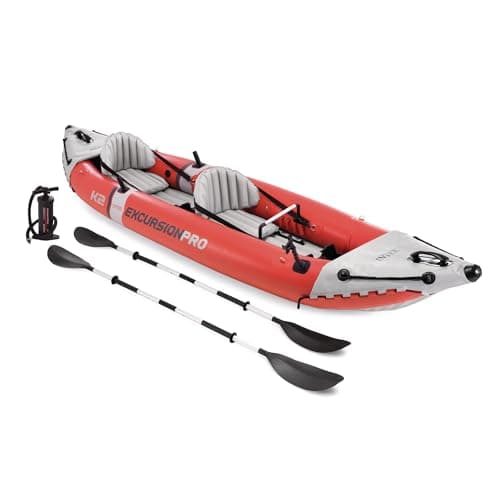
Best of the 400 lb boatsIntex Excursion Pro K2Forty-eight pounds is past the 50 lb checked-bag line once you add a bag, so this one drives rather than flies.
#ad Buy links are tagged Amazon Associates links. We earn a commission at no cost to you and it never changes the order.
The picks in full
#1 · Best inflatable kayak for a heavier paddler
Sea Eagle SE370
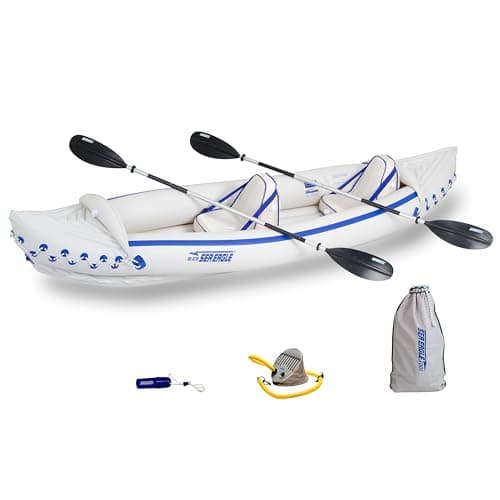
Twelve and a half feet of boat, 650 lb of capacity, 32 lb of hull, and it runs at 1.1 psi -- the lowest working pressure of anything here, which is why it is also one of the quickest to pump.
It is not close, and the arithmetic is why. Six hundred and fifty pounds of rated capacity worked to a two-thirds load is 433 lb, and once you take off 20 lb of paddle, PFD, water and dry bag, the boat still supports a 413 lb paddler. The next best figure in the registry that you can actually buy today is 247 lb. That margin is the entire point: a heavier paddler is not looking for a boat that technically accepts them, but one where they are nowhere near the line, because a hull loaded to its limit sits deep and paddles badly. Twelve feet six inches of hull sold as a three-person boat means the volume is genuinely there. Two honest cons. At 2 ft 10 in it is the narrowest of the multi-seat boats, so it is not the most initially stable thing here, and at 1.1 psi it is the softest hull in the registry -- which a heavier paddler will feel more than a light one, because the floor deflects under load.
The trade-off
Low pressure means a soft hull. It is forgiving and it is slow. The packed bag is 31 x 19 x 8 inches -- 58 linear inches, so it checks, but it is a bulky thing to carry through an airport.
#ad We earn a commission if you buy through this link, at no extra cost to you. It never changes the ranking. How this site is funded. Prices checked September 27, 2026.
Sea Eagle SE370 published specifications
Weight (hull or board)
32 lb
Weight (full system)
Not published
Packed size
31 x 19 x 8 in
Packed linear inches
58 in
Inflated
12 ft 6 in x 2 ft 10 in
Capacity
650 lb
Working pressure
1.1 psi
Floor pressure
Not published
Volume
Not published
Material
38 mil Polykrylar (K80 PVC)
Chambers
3
Valves
Five one-way air valves
Warranty
Not published
Computed · airline check
58 linear inches and 32 lb. Clears the 62-inch and 50 lb economy checked-bag limits.
Three-ply PVC over a polyester core, 12 ft 7 in long, 400 lb capacity, and 48 lb of it. The most substantial boat Intex makes and by some distance the heaviest thing in this registry.
Four hundred pounds rated is 267 lb at a working load and 247 lb of paddler once the kit is aboard, which covers a great many people the 300 lb boats do not. Among the three boats that land on that same 247 lb figure this is the one to take, because it pairs it with the widest beam we cover at 36 in and the longest hull at 12 ft 7 in -- width is what initial stability actually comes from, and length is what stops a heavily loaded boat from plowing. The cons: 48.14 lb is the heaviest hull in the registry to carry to the water, and Intex publishes neither a working pressure nor a chamber count, so the two specifications that tell you how firm it should be under load and what happens after a puncture are both blank.
The trade-off
Forty-eight pounds is past the 50 lb checked-bag line once you add a bag, so this one drives rather than flies. Intex again publishes no packed size and no working pressure.
#ad We earn a commission if you buy through this link, at no extra cost to you. It never changes the ranking. How this site is funded. Prices checked September 27, 2026.
Intex Excursion Pro K2 published specifications
Weight (hull or board)
48.14 lb
Weight (full system)
Not published
Packed size
Not published
Packed linear inches
Not published
Inflated
12 ft 7 in x 36 in
Capacity
400 lb
Working pressure
Not published
Floor pressure
Not published
Volume
Not published
Material
Three-ply PVC vinyl laminate with a polyester core
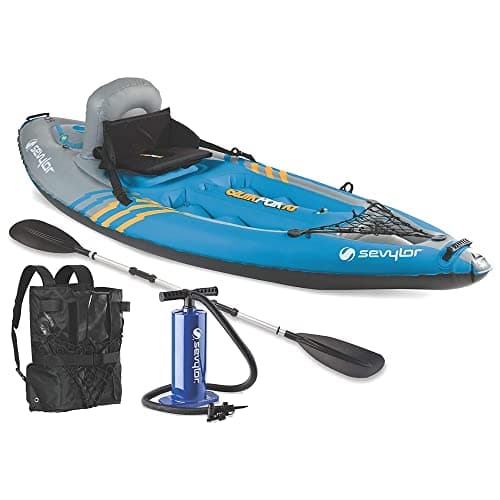
The bag is the seat and the seat is the bag. An 18 lb single that packs into a 31 x 9.25 x 17.5 inch backpack -- 57.75 linear inches, comfortably inside the checked-bag line, and you wear it to the water.
The same 400 lb rating and the same 247 lb paddler ceiling as the Intex tandems, but on an 18 lb hull in a backpack that unfolds into the seat -- so a heavier paddler who would rather not wrestle a 48 lb boat from the car has a real option. Three feet of beam is joint-widest in the registry. The cons are genuine: at 8 ft 7 in it is the shortest hull here, and a short boat carrying a heavy load sits deeper and holds a line less well, which is the specific trade you are making. Sevylor publishes no working pressure and no chamber count either, so how hard to pump it is a question the manufacturer does not answer.
The trade-off
Sevylor publishes no working pressure for it. On a 21-gauge PVC boat that matters, because the difference between a hull that tracks and a hull that folds is a couple of tenths of a psi.
#ad We earn a commission if you buy through this link, at no extra cost to you. It never changes the ranking. How this site is funded. Prices checked September 27, 2026.
Sevylor Quikpak K1 published specifications
Weight (hull or board)
18 lb
Weight (full system)
Not published
Packed size
31 x 9.25 x 17.5 in
Packed linear inches
57.8 in
Inflated
8 ft 7 in x 3 ft
Capacity
400 lb
Working pressure
Not published
Floor pressure
Not published
Volume
Not published
Material
21-gauge PVC with a tarpaulin bottom
Chambers
Not published
Valves
Not published
Warranty
Not published
Computed · airline check
57.8 linear inches and 18 lb. Clears the 62-inch and 50 lb economy checked-bag limits.
No photoWe have no photograph of this exact model that we can honestly publish
#4 · Skip this one if you are over 180 lb
Advanced Elements AdvancedFrame
Aluminum ribs in the bow and stern give it a defined shape that round inflatable tubes cannot, and it tracks like it. You pay for that in 36 lb and a folded package the size of a large duffel.
This is the boat the page exists to warn about, and it is a good boat. Seven air chambers is the best puncture margin in the registry and the aluminum ribs give it a defined entry nothing else here has. But 300 lb of rated capacity is 200 lb at a two-thirds working load, and once 20 lb of kit is aboard the paddler ceiling is 180 lb. A 200 lb paddler is over our planning line before they have packed anything, and the same is true of the Aquaglide Chelan 120 on identical numbers and of the PackLite at a 147 lb ceiling. None of those boats is badly made; they are simply rated for a lighter person than a lot of buyers are.
The trade-off
Thirty-six pounds folded to 30 x 17 x 10 inches. That is 57 linear inches -- inside the checked-bag line on size, but you are within 14 lb of the weight limit before you have added a pump or a paddle.
#ad We earn a commission if you buy through this link, at no extra cost to you. It never changes the ranking. How this site is funded. Prices checked September 27, 2026.
Advanced Elements AdvancedFrame published specifications
Weight (hull or board)
36 lb
Weight (full system)
Not published
Packed size
30 x 17 x 10 in
Packed linear inches
57 in
Inflated
10 ft 5 in x 32 in
Capacity
300 lb
Working pressure
2 psi
Floor pressure
1 psi
Volume
Not published
Material
PVC tarpaulin with aluminum bow and stern ribs
Chambers
7
Valves
Twistlok and military-style, 1 psi floor pressure-release valve
Warranty
Not published
Computed · airline check
57 linear inches and 36 lb. Clears the 62-inch and 50 lb economy checked-bag limits.
What is the best inflatable kayak for a heavier paddler?+
The Sea Eagle SE370. Its 650 lb rating works out to 433 lb at a two-thirds working load, which supports a 413 lb paddler once 20 lb of paddle, PFD, water and dry bag are aboard. Nothing else we cover is within 160 lb of that. If you want a lighter boat to carry, the Intex Excursion Pro K2 and the Sevylor QuikPak K1 both support a 247 lb paddler on the same arithmetic.
What weight limit do I need in an inflatable kayak?+
More than your own weight, and by a margin. Rated capacity is a maximum rather than a working load, so we plan to two thirds of it, then subtract the paddle, PFD, water and dry bag -- about 20 lb. Worked that way a 400 lb boat supports a 247 lb paddler and a 300 lb boat supports 180 lb. If your own weight is close to those figures the boat will float you and will also sit deep, paddle slowly and feel wet, which is not what anybody is buying.
Can a 250 lb person use an inflatable kayak?+
Yes, but the choice narrows sharply. On our arithmetic a 250 lb paddler is just past the 247 lb ceiling of the 400 lb boats -- close enough that they will work, with nothing to spare -- and comfortably inside the Sea Eagle SE370's 413 lb. The 300 lb boats, which include the Advanced Elements AdvancedFrame and the Aquaglide Chelan 120, cap out at a 180 lb paddler and are not the right purchase.
Are inflatable kayaks stable for a bigger paddler?+
Beam is the published figure that speaks to it, and the spread is narrow: 3 ft on both the Sevylor QuikPak K1 and the Intex Explorer K2, 36 in on the Intex Excursion Pro K2, 35 in on the Advanced Elements PackLite, down to 32 in on the AdvancedFrame. Note that the boat with the most capacity, the SE370, is one of the narrower ones at 2 ft 10 in -- capacity and initial stability are different properties and this registry does not rank them in the same order.
Do manufacturers publish a maximum paddler weight?+
No. Every boat here publishes a total rated capacity, which covers the paddler plus everything else aboard, and not one publishes a recommended working load or a maximum paddler weight. The paddler ceilings on this page are our arithmetic on their published ratings, using our stated two-thirds convention and a 20 lb kit -- substitute your own kit weight and the numbers move, but the ordering does not.
Units we claim to have tested: 0
Everyone in this category says they tested twenty boats. We have not tested any, and we say so. What we did instead: pulled the published specifications and the owner's manuals, computed the pump load and the packed volume for every model that publishes enough to compute them, checked the packed sizes against the airline limits you will actually meet, and cited every page we read. The full method.
Sources
Every specification on this page was read from one of these, on the date shown. Specs change between model years, so the date matters as much as the link.