Decide in the right order and the category narrows fast. Three of the four questions are answered by a number the manufacturer already published.
By Scooter M. · Published October 23, 2026 · Last updated October 23, 2026
DisclosureSome links on this page are Amazon Associates links. If you buy through one we earn a commission at no extra cost to you. It does not change what we recommend or the order we recommend it in -- here is how we rank, and here is how the site is funded.
For most buyers the answer is the Sea Eagle SE370, and the reason is that it is the only boat in this registry that does not force a choice. If you walk to the water, buy the Sevylor QuikPak K1 instead. If you drive to it and want the toughest skin, buy the Intex Excursion Pro K2. If the bag has to be small enough to carry on your back, there is exactly one answer and it is the Advanced Elements PackLite.
Those four answers come out of four questions asked in a fixed order. The order matters more than any individual specification, because each question eliminates boats that the next question would otherwise have let through.
The short version
Ask about the carry first. It eliminates more boats than the other three questions combined, and it is the reason most unused inflatables are unused.
Then capacity, worked to two thirds of the rating rather than the rating itself.
Then hull length against beam, which is the only published proxy for whether the boat holds a line.
Then disclosure. Three of our eight makers publish three of the four key specs; the rest leave you guessing after you have paid.
Question 1: where will it live, and how does it get to the water?
This is first because it is the question that decides whether the boat gets used, and because it is the one people answer last. A 48 lb bag that has to come down two flights of stairs is a boat that goes out twice a summer.
Two published specs answer it: hull weight, which everybody publishes, and packed size, which five of our eight manufacturers publish. Linear inches -- length plus width plus height -- is what an airline measures, and 62 is the economy checked limit at United, Delta and American alike. The full pack-size method is set out here.
Weight and packed size for every inflatable kayak in our registry
Model
Weight (lb)
Packed (in)
Linear in
Volume (L)
Under 62 in
Advanced Elements PackLite
4
11 x 11 x 5
27
9.9
Yes
Sevylor Quikpak K1
18
31 x 9.25 x 17.5
57.8
82.2
Yes
Sea Eagle SE370
32
31 x 19 x 8
58
77.2
Yes
Advanced Elements AdvancedFrame
36
30 x 17 x 10
57
83.6
Yes
Driftsun Voyager 2
27
26 x 16 x 8
50
54.5
Yes
Aquaglide Chelan 120
28.3
Not published
Not published
Not published
Not published
Intex Explorer K2
36.96
Not published
Not published
Not published
Not published
Intex Excursion Pro K2
48.14
Not published
Not published
Not published
Not published
Linear inches and liters are computed from the manufacturers' own packed dimensions. A 'Not published' row is a gap in the maker's specification, not in our research, and we do not estimate it.
Note what this question does to the two Intex boats. Both have strong figures elsewhere and neither publishes a packed size at all, so a buyer whose binding constraint is a cupboard or a car boot cannot evaluate them on the one spec that matters to them. That is not the same as the boats being large. It is worse, because it is unknowable in advance.
Question 2: what does it have to carry?
Add your own weight to your gear, and compare that against about two thirds of the boat's rating rather than the rating itself. A rating is the point at which the manufacturer stops making claims; a boat loaded to it sits low, pushes more water and handles badly. Why we use two thirds is worked through here.
Rated capacity and the two-thirds working load we plan with
Model
Type
Rated capacity (lb)
Two-thirds working load (lb)
Sea Eagle SE370
Kayak
650
433
Driftsun Voyager 2
Kayak
450
300
Intex Explorer K2
Kayak
400
267
Intex Excursion Pro K2
Kayak
400
267
Sevylor Quikpak K1
Kayak
400
267
Advanced Elements AdvancedFrame
Kayak
300
200
Aquaglide Chelan 120
Kayak
300
200
Advanced Elements PackLite
Kayak
250
167
Two thirds is this site's stated planning convention and not a manufacturer's figure. No maker in this registry publishes how it arrived at its rated number.
The practical floor for a single adult with gear is a 300 lb rating, which removes the PackLite at 250 lb. If anyone is coming with you, the answer changes sharply, because a tandem rating has to be divided between two seats before it means anything -- the per-seat arithmetic is on its own page, and it disqualifies three of the four tandems we cover for two adults.
Question 3: what water, and how far from shore?
Hull length divided by beam is the closest thing to a handling spec that falls out of numbers every manufacturer publishes. A longer, narrower hull holds a line and carries speed; a shorter, wider one turns easily and resists tipping. It knows nothing about rocker or tube cross-section, which is why the page that uses it does not rank on it alone.
Two answers fall out quickly. For sheltered water close to shore, width is worth more than length and the short wide boats are fine. For open water, a long hull and a high chamber count both start to matter, because the cost of a problem rises with the distance back.
Question 4: what will the maker actually tell you?
The last question is the one nobody asks, and it is the most useful filter in the category. Four specifications decide a purchase -- working pressure, chamber count, packed size and warranty term -- and across this registry most makers publish some and none publishes all four.
How many of the four decisive specifications each maker publishes
Brand
Boat
Working psi
Chambers
Packed size
Warranty
Published
Advanced Elements
Advanced Elements PackLite
Yes
Yes
Yes
No
3 of 4
Advanced Elements
Advanced Elements AdvancedFrame
Yes
Yes
Yes
No
3 of 4
Driftsun
Driftsun Voyager 2
Yes
Yes
Yes
No
3 of 4
Sea Eagle
Sea Eagle SE370
Yes
Yes
Yes
No
3 of 4
Aquaglide
Aquaglide Chelan 120
Yes
No
No
No
1 of 4
Sevylor
Sevylor Quikpak K1
No
No
Yes
No
1 of 4
Intex
Intex Explorer K2
No
No
No
No
0 of 4
Intex
Intex Excursion Pro K2
No
No
No
No
0 of 4
This counts disclosure, not quality. A brand can publish everything about a mediocre boat. But a blank is the one thing a buyer can never check after the fact, and across this registry the two turn out to track each other.
Material names. Every maker has a trade name for its skin and almost none publishes a thickness. Sea Eagle's 38 mil Polykrylar on the SE370 is the clearest figure anyone here states, so comparing "three-ply PVC" against "Duratex" is comparing marketing copy. What the material names actually mean is here.
Inflation time. Only one manufacturer in the kayak registry makes a time claim at all. We compute times where a volume is published, and no kayak maker publishes a chamber volume, so the kayak column of that table is blank. It is a real gap and not one we will fill with a guess.
Anything we would have had to paddle. We have not been in any of these boats. Every figure on this page is a manufacturer's published specification or arithmetic performed on one, which is a narrower claim than most guides make and a checkable one.
Working the four questions through
Answer one: you walk, cycle or fly to the water. The carry question takes you straight to the Sevylor QuikPak K1 at 18 lb, or to the PackLite at 7 lb for the complete system if the constraint is genuinely severe.
Answer two: you drive, and you want the boat to last. The carry question stops eliminating anything, capacity and skin take over, and the Intex Excursion Pro K2 wins on the toughest published fabric in the registry.
Answer three: you are not sure yet, or more than one person is coming. The Sea Eagle SE370 is the boat that keeps the most options open -- the highest capacity here, a packed size inside the airline limit, and a maker that publishes more than most.
Answer four: it is open water and you are going a distance from shore. The Advanced Elements AdvancedFrame's ribs and seven chambers are the structural answer, and you accept 36 lb to get them.
Best when you drive to the waterIntex Excursion Pro K2Forty-eight pounds is past the 50 lb checked-bag line once you add a bag, so this one drives rather than flies.
Best when pack size is the only questionAdvanced Elements PackLiteAt 2 psi in the side tubes and 1 psi in the floor there is very little structure here.
#ad Buy links are tagged Amazon Associates links. We earn a commission at no cost to you and it never changes the order.
The picks in full
#1 · Best all-round choice
Sea Eagle SE370
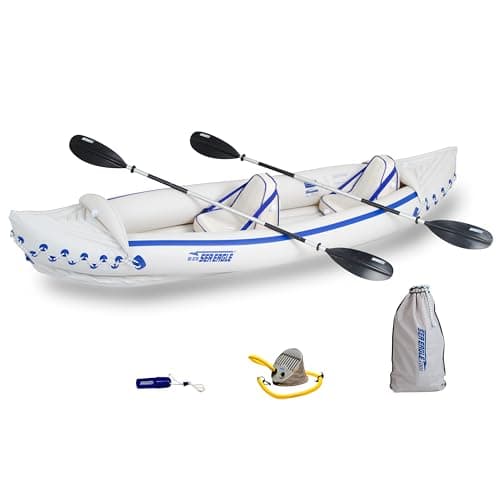
Twelve and a half feet of boat, 650 lb of capacity, 32 lb of hull, and it runs at 1.1 psi -- the lowest working pressure of anything here, which is why it is also one of the quickest to pump.
If you answer the four questions below and none of them pins you down, this is where you land. Six hundred and fifty pounds of rated capacity is the highest in the registry by 200 lb, it packs to 58 linear inches inside the airline limit, and Sea Eagle publishes a working pressure and an inflation-time claim when most of its competitors publish neither. It is also the only boat here sold for one, two or three paddlers, so it survives a change of mind about who is coming. Cons: 1.1 psi is the lowest working pressure we list and the hull is correspondingly soft, and at 12 ft 6 in and 32 lb it is a lot of boat to carry alone.
The trade-off
Low pressure means a soft hull. It is forgiving and it is slow. The packed bag is 31 x 19 x 8 inches -- 58 linear inches, so it checks, but it is a bulky thing to carry through an airport.
#ad We earn a commission if you buy through this link, at no extra cost to you. It never changes the ranking. How this site is funded. Prices checked October 29, 2026.
Sea Eagle SE370 published specifications
Weight (hull or board)
32 lb
Weight (full system)
Not published
Packed size
31 x 19 x 8 in
Packed linear inches
58 in
Inflated
12 ft 6 in x 2 ft 10 in
Capacity
650 lb
Working pressure
1.1 psi
Floor pressure
Not published
Volume
Not published
Material
38 mil Polykrylar (K80 PVC)
Chambers
3
Valves
Five one-way air valves
Warranty
Not published
Computed · airline check
58 linear inches and 32 lb. Clears the 62-inch and 50 lb economy checked-bag limits.
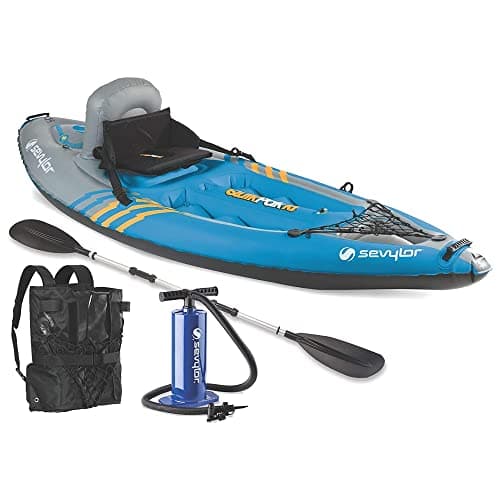
The bag is the seat and the seat is the bag. An 18 lb single that packs into a 31 x 9.25 x 17.5 inch backpack -- 57.75 linear inches, comfortably inside the checked-bag line, and you wear it to the water.
Question one eliminates more boats than the other three combined, and if your answer is that you walk to the water, this is the boat. Eighteen pounds, a bag that is a backpack and unfolds into the seat, 57.75 linear inches packed, and a 400 lb rating that is the highest of any single-seat boat we cover. It has a live Amazon price, which two thirds of this registry does not. Cons: 8 ft 7 in is the shortest hull here and it will not hold a line in wind, and Sevylor publishes no working pressure and no chamber count, so it scores two of four on disclosure.
The trade-off
Sevylor publishes no working pressure for it. On a 21-gauge PVC boat that matters, because the difference between a hull that tracks and a hull that folds is a couple of tenths of a psi.
#ad We earn a commission if you buy through this link, at no extra cost to you. It never changes the ranking. How this site is funded. Prices checked October 29, 2026.
Sevylor Quikpak K1 published specifications
Weight (hull or board)
18 lb
Weight (full system)
Not published
Packed size
31 x 9.25 x 17.5 in
Packed linear inches
57.8 in
Inflated
8 ft 7 in x 3 ft
Capacity
400 lb
Working pressure
Not published
Floor pressure
Not published
Volume
Not published
Material
21-gauge PVC with a tarpaulin bottom
Chambers
Not published
Valves
Not published
Warranty
Not published
Computed · airline check
57.8 linear inches and 18 lb. Clears the 62-inch and 50 lb economy checked-bag limits.
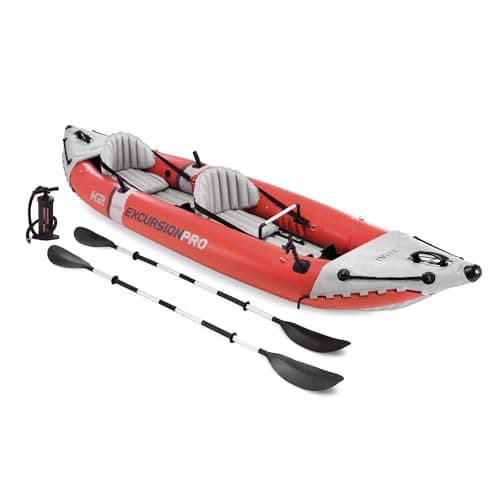
Three-ply PVC over a polyester core, 12 ft 7 in long, 400 lb capacity, and 48 lb of it. The most substantial boat Intex makes and by some distance the heaviest thing in this registry.
Remove the carry constraint and the answer changes completely. Three-ply PVC over a polyester core is the toughest skin in this registry, 12 ft 7 in is the second-longest hull, and the 400 lb rating is ample for one paddler with gear. It has a live Amazon price. The cons are the ones the carry question would have caught: 48.14 lb is the heaviest boat we cover, Intex publishes no packed size so you cannot plan a flight or a car boot around it, and no chamber count either.
The trade-off
Forty-eight pounds is past the 50 lb checked-bag line once you add a bag, so this one drives rather than flies. Intex again publishes no packed size and no working pressure.
#ad We earn a commission if you buy through this link, at no extra cost to you. It never changes the ranking. How this site is funded. Prices checked October 29, 2026.
Intex Excursion Pro K2 published specifications
Weight (hull or board)
48.14 lb
Weight (full system)
Not published
Packed size
Not published
Packed linear inches
Not published
Inflated
12 ft 7 in x 36 in
Capacity
400 lb
Working pressure
Not published
Floor pressure
Not published
Volume
Not published
Material
Three-ply PVC vinyl laminate with a polyester core
No photoWe have no photograph of this exact model that we can honestly publish
#4 · Best when the water decides
Advanced Elements AdvancedFrame
Aluminum ribs in the bow and stern give it a defined shape that round inflatable tubes cannot, and it tracks like it. You pay for that in 36 lb and a folded package the size of a large duffel.
If question three is the one you are stuck on and the answer is open water, this is the boat with the structural answer. Aluminum ribs in the bow and stern hold a defined entry that pressurized fabric cannot, which is what tracking actually depends on, and seven air chambers is more than double anything else here, which is the margin you want when the shore is far away. Cons: 36 lb is heavy for a single-seat boat, the 300 lb rating is mid-pack and leaves a 180 lb paddler at the working load, and there is no current Amazon listing, so the buy link is a tagged search.
The trade-off
Thirty-six pounds folded to 30 x 17 x 10 inches. That is 57 linear inches -- inside the checked-bag line on size, but you are within 14 lb of the weight limit before you have added a pump or a paddle.
#ad We earn a commission if you buy through this link, at no extra cost to you. It never changes the ranking. How this site is funded. Prices checked October 29, 2026.
Advanced Elements AdvancedFrame published specifications
Weight (hull or board)
36 lb
Weight (full system)
Not published
Packed size
30 x 17 x 10 in
Packed linear inches
57 in
Inflated
10 ft 5 in x 32 in
Capacity
300 lb
Working pressure
2 psi
Floor pressure
1 psi
Volume
Not published
Material
PVC tarpaulin with aluminum bow and stern ribs
Chambers
7
Valves
Twistlok and military-style, 1 psi floor pressure-release valve
Warranty
Not published
Computed · airline check
57 linear inches and 36 lb. Clears the 62-inch and 50 lb economy checked-bag limits.
No photoWe have no photograph of this exact model that we can honestly publish
#5 · Best when pack size is the only question
Advanced Elements PackLite
A 4 lb kayak that rolls to 11 x 11 x 5 inches. Nothing else in the category is close on either number, and the compromises are exactly the ones you would expect.
Eleven by eleven by five inches, 27 linear inches, and a complete 7 lb system. Nothing in the category is within 23 linear inches of it, so if the boat has to go in hand luggage or on your back there is exactly one answer and this is it. Cons, and they are severe if pack size is not your binding constraint: 250 lb is the lowest rating in the registry and leaves a 147 lb paddler at the working load, the 2 psi tubes over a 1 psi floor make it the softest hull here, and there is no current Amazon listing.
The trade-off
At 2 psi in the side tubes and 1 psi in the floor there is very little structure here. It is a boat for getting somewhere remote, not for a windy afternoon on open water.
#ad We earn a commission if you buy through this link, at no extra cost to you. It never changes the ranking. How this site is funded. Prices checked October 29, 2026.
Advanced Elements PackLite published specifications
In this order: packed size and weight, because that decides whether the boat gets used at all; rated capacity, worked to about two thirds and compared against your weight plus gear; hull length against beam, which is the closest published proxy for whether it holds a line; and how many of the four key specs the manufacturer is willing to publish at all. The last one is the most overlooked. Across our registry four of the eight boats, across three brands, publish three of the four, two publish one, and the two Intex boats publish none of them. A blank spec is the one thing you cannot check after the boat arrives.
What size inflatable kayak do I need?+
Capacity first, length second. Add your weight to your gear, then aim for roughly two thirds of the boat's rating rather than all of it, because a boat loaded to its maximum sits low and paddles badly. A 180 lb paddler with 20 lb of kit wants a rating of about 300 lb as a floor, which rules out the Advanced Elements PackLite at 250 lb. After capacity, longer hulls track better and pack bigger, and that trade is the whole category in one sentence.
What is the most important specification on an inflatable kayak?+
Packed size, and it is the one five of our eight manufacturers publish and three do not. Weight is published by everybody and spans 4 lb to 48.14 lb, but weight alone does not tell you whether the bag fits in your car, your cupboard or an airline's 62 linear inches. The three boats that withhold a packed size -- both Intex models and the Aquaglide Chelan 120 -- leave you finding out after the box arrives.
How many chambers should an inflatable kayak have?+
Three is the working standard in this registry and more is better, with the caveat that four of the eight makers do not publish a count at all. The Advanced Elements AdvancedFrame publishes seven, which is the largest margin we list. What a chamber count buys you is time: a puncture in a multi-chamber hull is a slow problem you paddle back from rather than a fast one.
How much should you spend on an inflatable kayak?+
We do not publish price brackets we have not verified, and our price layer is live, so where a boat has a current Amazon offer the button shows the real figure and the date it was read. What we can say is where the money goes: material thickness, a published working pressure, a packed size you can plan around, and a warranty term. The budget end of this registry withholds most of those, and that withholding is the clearest thing price buys.
Is an inflatable kayak the right kind of boat at all?+
Not if you own a garage and a roof rack. A hardshell is a better boat on the water and always will be, and the honest case for an inflatable is that it lives in a cupboard, travels in a hatchback and checks as luggage. If the storage and transport problem is not real for you, the compromise has no payoff.
Units we claim to have tested: 0
Everyone in this category says they tested twenty boats. We have not tested any, and we say so. What we did instead: pulled the published specifications and the owner's manuals, computed the pump load and the packed volume for every model that publishes enough to compute them, checked the packed sizes against the airline limits you will actually meet, and cited every page we read. The full method.
Sources
Every specification on this page was read from one of these, on the date shown. Specs change between model years, so the date matters as much as the link.