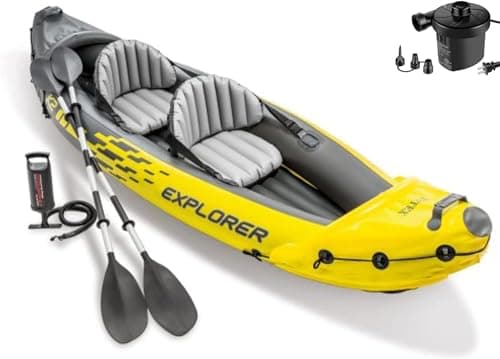
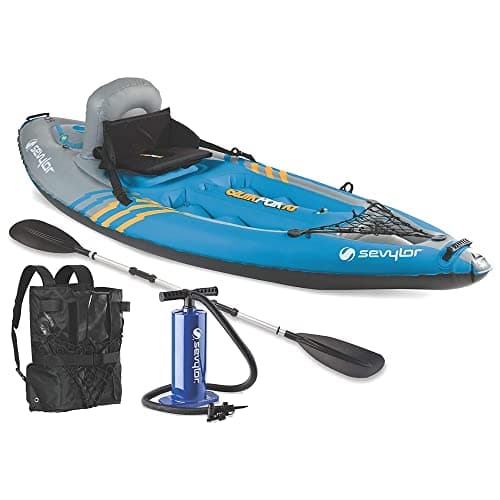
One seat and 18 lb, or two seats and nearly 37. These sit at about the same price and ask you to answer one question before anything else: do you ever actually paddle with someone?
By Scooter M. · Published September 20, 2026 · Last updated September 20, 2026
DisclosureSome links on this page are Amazon Associates links. If you buy through one we earn a commission at no extra cost to you. It does not change what we recommend or the order we recommend it in -- here is how we rank, and here is how the site is funded.
These are the two cheapest inflatable kayaks we hold specifications for, they sit at roughly the same money, and they are the pair a budget buyer genuinely cross-shops. On the two figures that get printed largest they are identical: both are rated to 400 lb and both are 3 ft wide.
Everything else about them is different, and the difference is not subtle. One weighs 18 lb and seats one. The other weighs 36.96 lb and seats two. So this comparison comes down to a question you can answer before reading any further: do you actually paddle with somebody, or do you just like the idea of being able to?
The short version
Identical on the headline numbers: 400 lb rated capacity and a 3 ft beam on both.
The Sevylor is 18 lb; the Intex is 36.96 lb. More than double, for no extra rated load.
Only the Sevylor publishes a packed size -- 57.75 linear inches, inside the airline limit.
Neither publishes a working pressure or a chamber count.
The Intex's 400 lb rating is about 267 lb at a sensible load, which is thin for two adults.
The two boats on published figures
Sevylor QuikPak K1 and Intex Explorer K2 compared
Specification
Sevylor QuikPak K1
Intex Explorer K2
Seats
1
2
Hull length
8 ft 7 in
10 ft 3 in
Beam
3 ft
3 ft
Length : beam (computed)
2.86 : 1
3.42 : 1
Hull weight
18 lb
36.96 lb
Rated capacity
400 lb
400 lb
Two-thirds working load (computed)
267 lb
267 lb
Packed size
31 x 9.25 x 17.5 in (57.75 linear in)
Not published
Working pressure
Not published
Not published
Chambers
Not published
Not published
Skin
21-gauge PVC, tarpaulin bottom
Rugged vinyl, I-beam floor
Manufacturer figures, read on 2 September 2026. Linear inches, the length-to-beam ratio and the two-thirds working load are our arithmetic on those figures. Prices are deliberately absent from this table -- they render live on the buy buttons with the date checked.
The same rating is not the same boat
Both boats are rated to 400 lb, and that identical number means two completely different things depending on how many people are using it.
On the Sevylor, 400 lb is one paddler's allowance. At the two-thirds working load we plan to, that is about 267 lb for a single person and their gear, which is generous for almost anybody.
On the Intex, the same 267 lb has to cover two people. Two 180 lb adults are 360 lb before a paddle, a PFD or a cooler goes in. The weight-limits guide explains why we work to two thirds rather than to the number on the box. The Explorer K2 is a genuine two-seat boat for two smaller paddlers, or an adult and a child, and it is thin for two average adults -- which is worth knowing before you buy it specifically for the second seat.
Nineteen pounds is the whole argument
The weight gap here is larger, proportionally, than any other pair of boats we compare. The Sevylor is less than half the Intex.
That matters because weight is the specification you meet on every single outing, twice. A boat you can pick up with one hand and walk to the water gets used on a whim; a boat that needs a deliberate plan and a free afternoon gets used less. Our lightest roundup ranks the whole registry on exactly that.
The Sevylor takes it further than the number suggests, because the bag is a backpack and the backpack unfolds into the seat. There is no separate carry, no second trip to the car, and nothing left over once the boat is inflated. It is the most genuinely useful piece of design in this registry at any price, and it is on the cheapest solo boat we cover.
What the Intex buys with the extra weight
A foot and a half of hull and a second seat, and it would be unfair to skip past either.
Ten feet three inches against 8 ft 7 in is 3.42 : 1 against 2.86 : 1 on length-to-beam, and a longer, narrower hull holds a line better -- the Sevylor is the second-lowest ratio in our whole registry. Our flat-water roundup explains what that ratio does and does not tell you. If your water is open and you paddle any distance, the extra length is a real advantage even with one person aboard.
The second seat is the other half, and it is the only thing here the Sevylor genuinely cannot do. A solo boat does not become a tandem.
On packed size they diverge, and this is the clearest practical difference on the page. Sevylor publishes 31 x 9.25 x 17.5 inches -- 57.75 linear inches, inside the 62-inch economy checked-bag limit. Intex publishes nothing, so the Explorer K2 cannot be checked against a car boot, a cupboard shelf or an airline before it arrives, and it cannot appear on our travel roundup at all for that reason.
When neither of these is the answer
Two thresholds push a buyer out of this bracket entirely, and it is worth naming them plainly rather than pretending the cheap end stretches further than it does.
If two adults really are going out together every time. Both boats here are rated to 400 lb, which is about 267 lb of sensible working load, and two average adults exceed that before gear. The Sea Eagle SE370 is rated to 650 lb and weighs less than the Explorer K2 while doing it, which is the one step in this category where paying more buys more of everything at once. That comparison is worth reading before you settle for 400 lb.
If the walk to the water is the hard part. The QuikPak K1 at 18 lb is already good at this, but the Advanced Elements PackLite is 4 lb and packs to 27 linear inches, which is a different category of portable. The trade is severe -- 250 lb of capacity and a soft 2 psi hull -- and it currently has no Amazon offer, so the buy link is a search. But if you are choosing the Sevylor specifically because you want to carry the boat, the lightest roundup shows what the next step up in portability costs.
Short of those two thresholds, the pair on this page genuinely covers the cheap end of the category, and the choice between them stays exactly where this page started: one seat and light, or two seats and heavy.
So which one
Buy the QuikPak K1 if you paddle alone, or if you are honest with yourself that the second seat would be used twice a year. At roughly the same money you get the same rated capacity, half the weight, a package you can check against an airline limit, and a boat you carry on your back.
Buy the Explorer K2 if two people really are going out together, or if the extra length matters on open water. Go in knowing that 400 lb is a thin rating for two adults and that you will be carrying nearly twice the weight to the water. Our value page covers where the money goes across the whole budget end, including the step up that buys no extra capacity at all.
#ad Buy links are tagged Amazon Associates links. We earn a commission at no cost to you and it never changes the order.
The picks in full
#1 · Better buy if you paddle alone
Sevylor Quikpak K1
The bag is the seat and the seat is the bag. An 18 lb single that packs into a 31 x 9.25 x 17.5 inch backpack -- 57.75 linear inches, comfortably inside the checked-bag line, and you wear it to the water.
Eighteen pounds against 36.96 for the same 400 lb rating and the same 3 ft beam, and the bag is a backpack that unfolds into the seat -- so the whole boat travels on your shoulders and there is nothing else to carry. It is also the only one of the two that publishes a packed size, at 57.75 linear inches, which clears the 62-inch checked-bag limit. The cons are real: an 8 ft 7 in hull is the second-shortest we cover and will not hold a line on open water, it seats one and only one, and Sevylor publishes neither a working pressure nor a chamber count.
The trade-off
Sevylor publishes no working pressure for it. On a 21-gauge PVC boat that matters, because the difference between a hull that tracks and a hull that folds is a couple of tenths of a psi.
#ad We earn a commission if you buy through this link, at no extra cost to you. It never changes the ranking. How this site is funded. Prices checked September 20, 2026.
Sevylor Quikpak K1 published specifications
Weight (hull or board)
18 lb
Weight (full system)
Not published
Packed size
31 x 9.25 x 17.5 in
Packed linear inches
57.8 in
Inflated
8 ft 7 in x 3 ft
Capacity
400 lb
Working pressure
Not published
Floor pressure
Not published
Volume
Not published
Material
21-gauge PVC with a tarpaulin bottom
Chambers
Not published
Valves
Not published
Warranty
Not published
Computed · airline check
57.8 linear inches and 18 lb. Clears the 62-inch and 50 lb economy checked-bag limits.
The cheapest way into a two-person inflatable, and the spec sheet is the shortest here: Intex publishes an inflated size, a weight and a capacity, and nothing a travel buyer can plan around.
It is the cheapest way to get two seats on the water and a foot and a half more hull, at 10 ft 3 in, which tracks better than the Sevylor for the paddler sitting in it. That is the entire case for it and it is a legitimate one. The cons stack up quickly though: 36.96 lb is more than double the Sevylor for no extra rated load, Intex publishes no packed size, no working pressure and no chamber count, and at a sensible two-thirds working load its 400 lb rating leaves about 267 lb -- which is less than two average adults before anybody packs anything.
The trade-off
No published packed size and no published working pressure. You are buying 37 lb of vinyl on trust, and you will not know whether it fits your checked bag until it arrives.
#ad We earn a commission if you buy through this link, at no extra cost to you. It never changes the ranking. How this site is funded. Prices checked September 20, 2026.
Which is better, the Sevylor QuikPak K1 or the Intex Explorer K2?+
For one paddler, the QuikPak K1, and it is not close: same rated capacity, same beam, less than half the weight, and it publishes a packed size that the Intex does not. The Explorer K2 wins only on the thing the Sevylor cannot do at all, which is carry a second person. Both sit at roughly the same money, so this is a question about how you paddle rather than about budget.
Can two adults really use the Intex Explorer K2?+
It has two seats and a 400 lb rating, so yes in the sense that it will float them. We plan to two thirds of any rating because a boat loaded to its maximum sits low and paddles badly, and two thirds of 400 lb is about 267 lb. Two 180 lb adults are 360 lb before gear. It works for two smaller paddlers on flat water, or for one adult and a child, and it is thin for two average adults.
Why does the one-person kayak weigh half as much?+
Less boat and a different skin. The QuikPak K1 is 8 ft 7 in of 21-gauge PVC with a tarpaulin bottom; the Explorer K2 is 10 ft 3 in of rugged vinyl with an inflatable I-beam floor and a second seat. Neither manufacturer publishes a working pressure, so the one figure that would tell you how firm each is meant to be is missing from both spec sheets.
Can either of these be checked as airline luggage?+
The QuikPak K1 can, on published figures: 31 x 9.25 x 17.5 inches is 57.75 linear inches, inside the 62-inch economy limit, and at 18 lb it is well under the 50 lb weight limit. The Explorer K2 cannot be checked with any confidence, because Intex publishes no packed dimensions at all -- which is the single most useful figure this comparison turns on.
Do both come with a pump and paddle?+
Both are currently sold as packages that include them, according to the listing titles we checked on 20 September 2026 -- the Sevylor lists a hand pump and paddle, the Intex lists aluminum oars and a high-output pump. Package contents change between sellers and seasons more often than the boats do, so confirm what a specific listing includes at the moment you buy.
Units we claim to have tested: 0
Everyone in this category says they tested twenty boats. We have not tested any, and we say so. What we did instead: pulled the published specifications and the owner's manuals, computed the pump load and the packed volume for every model that publishes enough to compute them, checked the packed sizes against the airline limits you will actually meet, and cited every page we read. The full method.
Sources
Every specification on this page was read from one of these, on the date shown. Specs change between model years, so the date matters as much as the link.