Inflatable kayak or canoe: which one you actually need
Most people asking this want a canoe's carrying capacity without a canoe's storage problem. One boat in our registry gets closer to that than you would expect.
By Scooter M. · Published September 12, 2026 · Last updated September 12, 2026
DisclosureSome links on this page are Amazon Associates links. If you buy through one we earn a commission at no extra cost to you. It does not change what we recommend or the order we recommend it in -- here is how we rank, and here is how the site is funded.
People asking this question are usually not choosing between two boats they both want. They want what a canoe does -- carry people and gear, sit in open water comfortably, take a cooler and a dog and a tent -- without owning something 16 feet long that needs a garage and a roof rack.
So the useful version of this comparison is not "which is better". It is how much of a canoe an inflatable kayak can actually replace, and where the substitution genuinely fails.
One thing to say before any table: this site holds published specifications for eight inflatable kayaks and none at all for canoes. The inflatable side of everything below is measured and cited. The canoe side is described from hull form rather than specified, and we are not going to invent figures to make a comparison look tidier.
The short version
A canoe carries more. That is what the hull is for and we are not arguing it away.
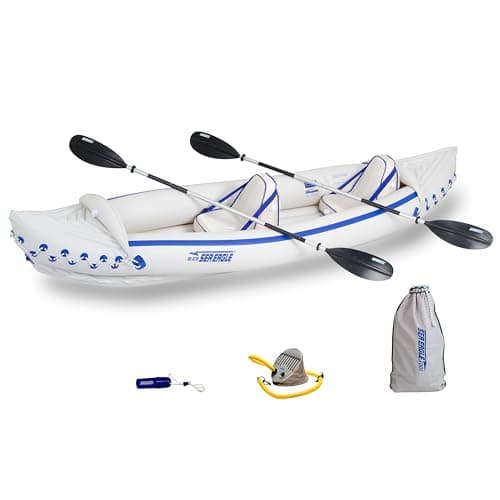
The Sea Eagle SE370's 650 lb rating is the closest an inflatable in our registry gets to canoe capacity.
Five of our eight kayaks publish a packed size, and all five clear the 62-inch checked-bag limit. No canoe has an answer to that.
Beam is closer than expected: 32 to 36 in across our registry is canoe-like width.
What you cannot get from any inflatable here: kneeling, a high seating position, and room to move around.
Where the canoe wins
Load. This is the real one. A tandem canoe is built to haul people plus a serious load of gear, and nothing in our registry matches that. Our eight kayaks are rated between 250 lb and 650 lb, and because a rating is a maximum rather than a target we plan to two thirds of it -- so usable loads run from about 167 lb to 433 lb. The weight-limits guide explains the convention, and even at the top of our range the SE370 is carrying a day's gear rather than a week's.
Position and posture. A canoe lets you kneel, which lowers your center of gravity and is the most secure way to paddle rough water. It also lets you move around, change seats, and reach gear stowed behind you. No inflatable kayak in our registry offers any of that -- you are seated, low, with your legs in front of you, for the whole trip.
Wind. An inflatable rides high on the water and presents a lot of side area for its weight. A canoe, particularly a loaded one, sits lower and holds its line better in a crosswind. That is a consequence of hull form rather than a figure we can cite, because nobody in this registry publishes freeboard.
Where the inflatable kayak wins
It fits your life. Five of our eight kayaks publish a packed size and every one of the five clears the 62-inch economy checked-bag limit. The Advanced Elements PackLite does it at 27 linear inches with a complete 7 lb system, which is small enough to walk in with. The travel roundup ranks all of them against both airline limits. A canoe has no equivalent at any price, and for most people asking this question that single fact decides it.
Nobody has to help you. A tandem canoe is a two-person lift onto a roof rack. The Driftsun Voyager 2 is 27 lb in a bag that measures 50 linear inches, which one person carries from a car to the water without thinking about it. The number of trips that actually happen is strongly related to how annoying the boat is to move.
Punctures are survivable. Multi-chamber construction is standard on the kayaks we cover -- three chambers on most, seven on the Advanced Elements AdvancedFrame -- so losing one chamber is a slow paddle back rather than a swim. The chambers guide covers what that redundancy is worth.
How close does the SE370 actually get?
Closer than any other inflatable we hold figures for, and it is worth setting out why, because it is the boat that makes this substitution work when it works.
The inflatable kayaks in our registry that come closest to a canoe's job
Model
Length
Beam
Rated capacity
Two-thirds load
Packed
Sea Eagle SE370
12 ft 6 in
2 ft 10 in
650 lb
433 lb
58 linear in
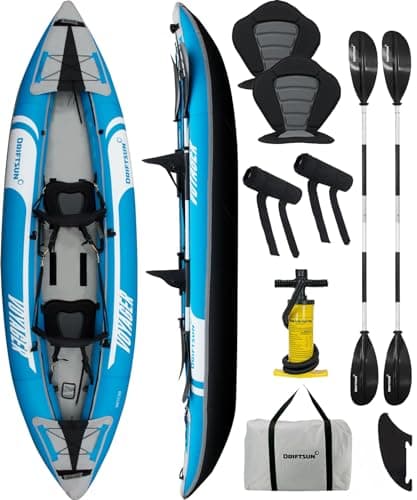
Driftsun Voyager 2
10 ft
35 in
450 lb
300 lb
50 linear in
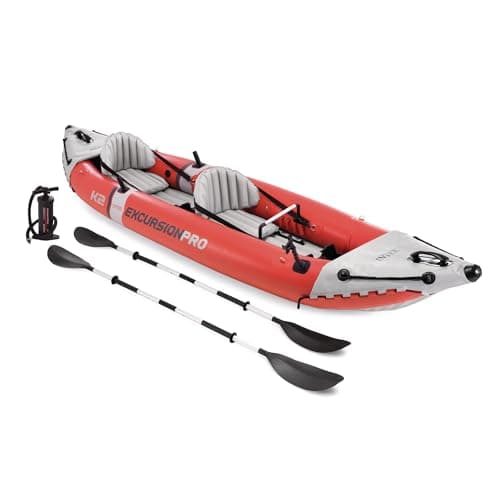
Intex Excursion Pro K2
12 ft 7 in
36 in
400 lb
267 lb
Not published
Intex Explorer K2
10 ft 3 in
3 ft
400 lb
267 lb
Not published
Manufacturer figures, read on 2 September 2026. The two-thirds working load and linear inches are our arithmetic. Canoe figures are deliberately absent -- we hold no published specifications for canoes.
Six hundred and fifty pounds in an open 12 ft 6 in hull sold as a one-to-three person boat is, functionally, a small canoe that rolls into a bag. It runs at 1.1 psi, which is the lowest working pressure in our registry and the reason it reaches that capacity on only 32 lb of material -- you are buying buoyancy with air rather than with hull.
Buy a canoe if you are hauling a real load, going out for more than a day, paddling with children who need room to move, or you already have somewhere to keep 16 feet of boat. Nothing here replaces it for those jobs.
Buy an inflatable kayak if the honest constraint is storage, transport or the fact that a canoe would mean a roof rack and a second person every single time. The SE370 gets you most of the way on capacity, and the tandem roundup covers the rest of the field.
Best for hauling gear by carIntex Excursion Pro K2Forty-eight pounds is past the 50 lb checked-bag line once you add a bag, so this one drives rather than flies.
Best if storage is the whole problemDriftsun Voyager 2Twenty-seven pounds and 450 lb of capacity in a 10 ft hull means two adults sit close and sit low.
#ad Buy links are tagged Amazon Associates links. We earn a commission at no cost to you and it never changes the order.
The picks in full
#1 · The closest thing to a canoe here
Sea Eagle SE370
Twelve and a half feet of boat, 650 lb of capacity, 32 lb of hull, and it runs at 1.1 psi -- the lowest working pressure of anything here, which is why it is also one of the quickest to pump.
Six hundred and fifty pounds of rated capacity in a 12 ft 6 in open hull that Sea Eagle sells as a one-to-three-person boat -- that is canoe territory on both counts, and nothing else in our registry is close. It packs to 58 linear inches and 32 lb, which is the part no canoe can answer. The cons are the ones a canoeist would notice immediately: at 1.1 psi it is a soft hull that flexes and is slow, it sits higher and catches more wind than a canoe, and you paddle it seated with a double blade rather than kneeling with a single.
The trade-off
Low pressure means a soft hull. It is forgiving and it is slow. The packed bag is 31 x 19 x 8 inches -- 58 linear inches, so it checks, but it is a bulky thing to carry through an airport.
#ad We earn a commission if you buy through this link, at no extra cost to you. It never changes the ranking. How this site is funded. Prices checked September 12, 2026.
Sea Eagle SE370 published specifications
Weight (hull or board)
32 lb
Weight (full system)
Not published
Packed size
31 x 19 x 8 in
Packed linear inches
58 in
Inflated
12 ft 6 in x 2 ft 10 in
Capacity
650 lb
Working pressure
1.1 psi
Floor pressure
Not published
Volume
Not published
Material
38 mil Polykrylar (K80 PVC)
Chambers
3
Valves
Five one-way air valves
Warranty
Not published
Computed · airline check
58 linear inches and 32 lb. Clears the 62-inch and 50 lb economy checked-bag limits.
Three-ply PVC over a polyester core, 12 ft 7 in long, 400 lb capacity, and 48 lb of it. The most substantial boat Intex makes and by some distance the heaviest thing in this registry.
Twelve feet seven inches of hull with a 36 in beam and the toughest skin in our registry -- a three-ply PVC laminate over a polyester core -- which is the closest match here for the scrapes a loaded boat takes at a rocky put-in. The cons are real: 400 lb of rated capacity is 267 lb at a sensible working load, which is well short of what a tandem canoe carries, and at 48.14 lb it is the heaviest thing we list and publishes no packed size at all.
The trade-off
Forty-eight pounds is past the 50 lb checked-bag line once you add a bag, so this one drives rather than flies. Intex again publishes no packed size and no working pressure.
#ad We earn a commission if you buy through this link, at no extra cost to you. It never changes the ranking. How this site is funded. Prices checked September 12, 2026.
Intex Excursion Pro K2 published specifications
Weight (hull or board)
48.14 lb
Weight (full system)
Not published
Packed size
Not published
Packed linear inches
Not published
Inflated
12 ft 7 in x 36 in
Capacity
400 lb
Working pressure
Not published
Floor pressure
Not published
Volume
Not published
Material
Three-ply PVC vinyl laminate with a polyester core
The smallest packed box of any tandem here at 26 x 16 x 8 inches -- 50 linear inches, twelve inches of headroom under the checked-bag line, which no other two-person boat in this registry has.
Fifty linear inches packed and 27 lb, which is the smallest tandem package in our registry -- this is the boat for somebody who wants two-person paddling and has nowhere to put a canoe. Three chambers and a published 2 psi working pressure put it ahead of the Intex boats on disclosure. The con is capacity: 450 lb rated is 300 lb at two-thirds load, so it carries two adults and light gear rather than a canoe's load of camping kit.
The trade-off
Twenty-seven pounds and 450 lb of capacity in a 10 ft hull means two adults sit close and sit low. It is a lake and slow-river boat, not a touring one.
#ad We earn a commission if you buy through this link, at no extra cost to you. It never changes the ranking. How this site is funded. Prices checked September 12, 2026.
Driftsun Voyager 2 published specifications
Weight (hull or board)
27 lb
Weight (full system)
Not published
Packed size
26 x 16 x 8 in
Packed linear inches
50 in
Inflated
10 ft x 35 in
Capacity
450 lb
Working pressure
2 psi
Floor pressure
1 psi
Volume
Not published
Material
Reinforced PVC, three-chamber construction
Chambers
3
Valves
Boston valves
Warranty
Not published
Computed · airline check
50 linear inches and 27 lb. Clears the 62-inch and 50 lb economy checked-bag limits.
Is an inflatable kayak a good substitute for a canoe?+
For day paddling with one or two people and light gear, often yes -- and the storage difference is decisive for anybody without a garage. For hauling a real load, for kneeling to paddle, or for a multi-day trip with camping kit, no. The highest rated capacity in our registry is the Sea Eagle SE370's 650 lb, which is respectable for an inflatable and still short of what a tandem canoe is built to carry.
Which carries more, a canoe or an inflatable kayak?+
A canoe, in general and usually by a wide margin -- that is what the hull form is for. We hold no published specifications for canoes, so we are not going to attach a number to the gap. What we can tell you is our side of it: the eight inflatable kayaks we cover are rated between 250 lb and 650 lb, and we plan to two thirds of any rating, which puts usable loads between about 167 lb and 433 lb.
Is a canoe more stable than an inflatable kayak?+
Initial stability is closer than people expect. Inflatable kayaks are wide for their length -- our registry runs 32 to 36 inches of beam, which is canoe-like -- and they sit on the water rather than in it. What a canoe gives you is a higher seating position, room to move around, and the option to kneel, which is a genuinely more secure position that no inflatable kayak in our registry offers.
What does an inflatable kayak do that a canoe cannot?+
Fit in a cupboard, travel in a hatchback, and go on a plane. Five of our eight kayaks publish a packed size and all five clear the 62-inch economy checked-bag limit; the Advanced Elements PackLite does it at 27 linear inches with a complete 7 lb system. A canoe has no equivalent answer at any price, and for most people asking this question that is the fact that settles it.
Which handles wind better?+
A canoe, generally, because it sits lower relative to its mass and a loaded canoe sits lower still. An inflatable rides high and presents more side area for its weight, so a crosswind moves it further off line. Nobody in our registry publishes freeboard or windage, so this is reasoning from published weights and hull depths rather than a measurement, and we will not put a number on it.
Units we claim to have tested: 0
Everyone in this category says they tested twenty boats. We have not tested any, and we say so. What we did instead: pulled the published specifications and the owner's manuals, computed the pump load and the packed volume for every model that publishes enough to compute them, checked the packed sizes against the airline limits you will actually meet, and cited every page we read. The full method.
Sources
Every specification on this page was read from one of these, on the date shown. Specs change between model years, so the date matters as much as the link.