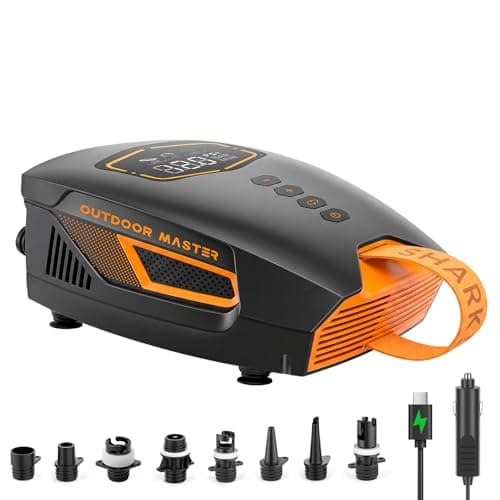
OutdoorMaster Shark 3 Mini
The quickest pump to 15 psi of anything we cover, and the only cordless one -- bought at a weight the pump it replaces did not ask for.
By Scooter M. · Published November 5, 2026 · Last updated November 5, 2026

- Published 450 L/min high-volume stage and 110 L/min at pressure, to 20 psi.
- 74 Wh internal battery, rated by OutdoorMaster at six boards per charge.
- Computes to about 3.4 minutes for a 300 L board at 15 psi -- the quickest figure on this site.
- 4.4 lb, the heaviest of the four pumps here whose makers publish a weight.
OutdoorMaster publishes two flow figures for this pump, 450 L/min and 110 L/min, and a 20 psi ceiling. Run those through the same two-stage model this site uses for every other electric pump and a 300 L board at 15 psi comes out at about 3.4 minutes: roughly two thirds of a minute to fill the shape and about two and three quarters to pressurize it.
That is the quickest computed figure on the site. The corded Shark II is 5.2 minutes on the same board and the single-stage Bravo BP12 is 3.8.
The stage labels are ours, not theirs
OutdoorMaster lists "450L/min" and "110L/min" without saying which belongs to which stage. We assign the larger to the high-volume stage and the smaller to the high-pressure one, because that is the order its own Shark II sheet uses and because no two-stage pump works the other way round. It is an assumption, and it is the only one in the figure above.
Six boards, and no way to top it up
The 74 Wh battery is rated by OutdoorMaster at six boards per charge, which is double what the discontinued Cachalot 2S managed on 57.72 Wh. On a weekend that is the difference between planning around the pump and forgetting about it.
The constraint is unchanged in shape, though: a battery pump has a finite number of inflations in it and nothing to plug into when they run out. Four days at a lake with no hookup is still an argument for carrying the 1.65 lb hand pump as well rather than instead.
At 74 Wh it sits inside the 100 Wh threshold airlines generally apply to lithium batteries in the cabin, so it is a pump you can fly with -- in hand luggage, not in the hold, and your carrier's published rule is the one that counts.
The weight is the real cost
Four point four pounds is the heaviest of the four pumps here whose makers publish a weight -- heavier than the corded Shark II at 3.6 lb, which is an odd result for the portable option, and two thirds again heavier than the 2.65 lb Cachalot 2S it effectively replaces.
That lands hardest on exactly the buyer a cordless pump is for. Against the Advanced Elements PackLite's complete 7 lb system it is a 63 percent increase in what you carry; the kayak pump page works that through. Against a 50 lb airline allowance it is affordable. Against a mile of trail it is a decision.
Who this is for
Anybody who inflates away from a car and wants it over quickly: campers, travelers, and anyone whose launch has no parking next to it. It is also the right pump if you run several boards in a session, because a six-board charge and the quickest total time here compound.
Who should skip it
Anybody who always parks at the launch should buy the corded Shark II instead: it is lighter, cheaper, has no charge to manage and no per-charge ceiling, and the extra minute and a half per board is not worth the difference. And anybody whose binding constraint is carry weight should know that the lightest cordless option in this category is no longer sold, and that 4.4 lb is what the market currently offers.
OutdoorMaster Shark 3 Mini: the published specification
Everything OutdoorMaster publishes for this model, read on November 5, 2026. Rows marked "Not published" are gaps in the manufacturer's own specification -- we do not fill them with estimates.
| Weight (hull or board) | 4.4 lb |
|---|---|
| Weight (full system) | Not published |
| Packed size | Not published |
| Packed linear inches | Not published |
| Inflated | Not published |
| Capacity | Not published |
| Working pressure | 20 psi |
| Floor pressure | Not published |
| Volume | Not published |
| Material | Not published |
| Chambers | Not published |
| Valves | Not published |
| Warranty | Not published |
#ad We earn a commission if you buy through this link, at no extra cost to you. It never changes the ranking. How this site is funded. Prices checked November 6, 2026.
Questions people actually ask
How long does the Shark 3 Mini take to inflate a paddle board?
How many boards will the Shark 3 Mini do on one charge?
Can you use the Shark 3 Mini without charging it?
Is the Shark 3 Mini worth it over the corded Shark II?
Everyone in this category says they tested twenty boats. We have not tested any, and we say so. What we did instead: pulled the published specifications and the owner's manuals, computed the pump load and the packed volume for every model that publishes enough to compute them, checked the packed sizes against the airline limits you will actually meet, and cited every page we read. The full method.
Sources
Every specification on this page was read from one of these, on the date shown. Specs change between model years, so the date matters as much as the link.
- OutdoorMaster Shark 3 Mini specifications — read November 5, 2026
- OutdoorMaster Shark 3 Mini listing, Amazon — read November 5, 2026