The best one-person inflatable kayaks, ranked on what you carry
A solo boat is bought by the person who also has to lift it. These four span 4 lb to 36 lb and 250 lb to 400 lb of capacity, which is the whole decision.
By Scooter M. · Published September 21, 2026 · Last updated September 21, 2026
DisclosureSome links on this page are Amazon Associates links. If you buy through one we earn a commission at no extra cost to you. It does not change what we recommend or the order we recommend it in -- here is how we rank, and here is how the site is funded.
A solo inflatable kayak is bought by the person who also has to carry it, park it, and get it out of a car alone. That changes the calculation in a way most roundups miss: on a tandem the weight is shared and the capacity is split, and on a single-seat boat both land on one person.
The four single-seat boats we hold specifications for span 4 lb to 36 lb of hull and 250 lb to 400 lb of rated capacity. Those two ranges are the entire decision, and they do not move together -- the lightest boat here has the lowest ceiling, and the heaviest is not the one that carries most.
The short version
Hull weight spans 4 lb to 36 lb -- a factor of nine across four boats.
Capacity does not follow weight: the 18 lb Sevylor carries 400 lb, the 36 lb AdvancedFrame carries 300 lb.
Only the Aquaglide Chelan 120 has a rigid floor: 6 psi drop-stitch under 3 psi tubes.
Two of the four publish a packed size. The other two leave a solo buyer guessing about the carry.
A solo boat is not automatically lighter than a tandem -- the AdvancedFrame is 9 lb heavier than the two-seat Voyager 2.
What we judged these on
Four criteria, in the order a single paddler meets them.
Carry weight first, because it is the thing you experience twice on every trip with nobody to share it. Our registry runs 4 lb to 36 lb here, and that spread is larger than anything else on the page.
Usable capacity second. A rating is a maximum rather than a working load, so we plan to two thirds of it -- which turns 400 lb into about 267 lb and 250 lb into about 167 lb. The weight-limits guide explains the convention, and on a solo boat it binds sooner than people expect once a cooler or a dog is involved.
Floor and structure third. Alone in a boat, the deck is what you brace against, and a soft 1 to 2 psi floor deforms under a shifting load in a way a rigid panel does not.
Published packed size fourth, because a solo buyer is disproportionately likely to be the person putting the boat in a small car or on a plane.
The four solo boats, side by side
Single-seat inflatable kayaks on published figures
Model
Hull (lb)
Length
Capacity (lb)
Two-thirds load (lb)
Floor
Packed
Sevylor QuikPak K1
18
8 ft 7 in
400
267
Soft, pressure not published
57.75 linear in
Aquaglide Chelan 120
28.3
11 ft 3 in
300
200
6 psi drop-stitch, rigid
Not published
Advanced Elements AdvancedFrame
36
10 ft 5 in
300
200
1 psi, soft
57 linear in
Advanced Elements PackLite
4
7 ft 10 in
250
167
1 psi, soft
27 linear in
Manufacturer figures, read on 2 September 2026. The two-thirds working load is our arithmetic and our stated convention -- no manufacturer publishes a recommended working load, only a maximum.
Weight and capacity do not move together
The most useful thing in that table is that the two columns disagree. The lightest boat has the lowest ceiling, which you would expect. But the heaviest boat does not have the highest -- the 36 lb AdvancedFrame is rated to 300 lb while the 18 lb Sevylor is rated to 400 lb.
That is because capacity comes from displacement and weight comes from material. The AdvancedFrame spends its pounds on a PVC tarpaulin skin and aluminum ribs rather than on hull volume, which buys tracking and puncture margin instead of load. If you are shopping on the assumption that a heavier solo boat carries more, this page is the correction.
The floor is the specification nobody compares
Three of these four run a soft floor at 1 to 2 psi, or do not publish a pressure at all. One does not: the Chelan 120 puts a 6 psi drop-stitch panel under 3 psi tubes, which is the only genuinely rigid deck in our registry.
Alone in a boat that matters more than it does in a tandem. There is nobody to balance against, so every shift of weight -- reaching for a dry bag, turning to look behind you, getting back in from the water -- goes through the floor. A rigid panel gives you something definite to push against; a soft one moves with you. The Chelan against the AdvancedFrame is the sharpest version of that choice -- a rigid floor or a rigid frame, at the same 300 lb rating.
Where you can buy each of these
Worth stating plainly, because it differs across this page. The Sevylor QuikPak K1 has a live Amazon offer, so its buy button goes to the listing with the current price. The Chelan 120 and the two Advanced Elements boats have no Amazon buy-box offer at the moment, so their buttons are tagged Amazon searches -- the click still works and lands you on whatever is genuinely listed today.
All three are well stocked elsewhere as we write: the Chelan 120 at REI, Backcountry, Campmor and Sportsman's Warehouse, and the AdvancedFrame and PackLite at B&H, Scuba.com, Air Kayaks and Walmart, all checked on 21 September 2026.
Getting back in, with nobody to help
This is the solo-specific problem the category never addresses, and we should be straight that it is not a published specification. Not one manufacturer in this registry states anything about re-entry from deep water -- no figure, no rating, no claim.
What the spec sheets do tell you is the two things that bear on it. Beam is the first: these four run 32 in to 36 in, and a wider hull resists being pulled over as you haul yourself across it. Floor rigidity is the second, and it is where they genuinely differ -- hauling onto a 6 psi drop-stitch deck is pushing against something solid, while a 1 psi floor folds under a concentrated load exactly when you need it not to.
That is reasoning from published figures rather than a test result, and we are not going to dress it up as more. It is also the single best argument for staying inside a distance you would be content to swim when you are out on your own.
The boat we did not rank here
One omission is deliberate and worth explaining. Sea Eagle sells the SE370 as a one-to-three-person boat, so it is legitimately a solo option, and at 650 lb rated it carries more than anything on this page by 250 lb.
It is not ranked as a solo because 12 ft 6 in and a 58-linear-inch bag is a great deal of boat for one person to inflate, carry and trim, and paddled alone a three-person hull sits badly off its balance point. If your reason for wanting a solo is capacity rather than portability, though, it is the honest answer and the one we rank first among tandems. The value page covers where it sits against the cheaper boats.
When a tandem is the better solo boat
One honest caveat before the picks. A two-person boat paddled alone is not a disaster -- most tandems let you move the seat toward the middle to fix the trim, and you get more hull and usually more capacity for the money.
Ranked on usable capacity against carry weight, with floor rigidity breaking the close calls and the honest cost of each named. Every figure is a manufacturer's published specification or arithmetic done on one, and we have not paddled any of it.
Best on the waterAquaglide Chelan 120Aquaglide does not publish a packed size for this boat, so you cannot check it against an airline limit before you buy it -- and it is the one number a travel buyer needs most..
Skip this one unless the carry is the whole pointAdvanced Elements PackLiteAt 2 psi in the side tubes and 1 psi in the floor there is very little structure here.
#ad Buy links are tagged Amazon Associates links. We earn a commission at no cost to you and it never changes the order.
The picks in full
#1 · Best solo kayak overall
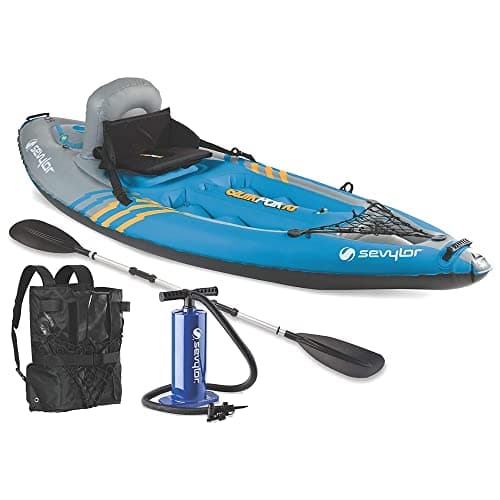
Sevylor Quikpak K1
The bag is the seat and the seat is the bag. An 18 lb single that packs into a 31 x 9.25 x 17.5 inch backpack -- 57.75 linear inches, comfortably inside the checked-bag line, and you wear it to the water.
Four hundred pounds of rated capacity is the highest of any single-seat boat we cover, and it arrives on an 18 lb hull whose bag is a backpack that unfolds into the seat -- so one person carries the entire boat hands-free and has nothing left over at the water. It is also the only solo here with a live Amazon price and a published packed size, at 57.75 linear inches, inside the checked-bag limit. The cons are genuine: at 8 ft 7 in it is the shortest hull on this page and will not hold a line on open water, and Sevylor publishes neither a working pressure nor a chamber count, so how firm it should be and what happens after a puncture are both unstated.
The trade-off
Sevylor publishes no working pressure for it. On a 21-gauge PVC boat that matters, because the difference between a hull that tracks and a hull that folds is a couple of tenths of a psi.
#ad We earn a commission if you buy through this link, at no extra cost to you. It never changes the ranking. How this site is funded. Prices checked September 21, 2026.
Sevylor Quikpak K1 published specifications
Weight (hull or board)
18 lb
Weight (full system)
Not published
Packed size
31 x 9.25 x 17.5 in
Packed linear inches
57.8 in
Inflated
8 ft 7 in x 3 ft
Capacity
400 lb
Working pressure
Not published
Floor pressure
Not published
Volume
Not published
Material
21-gauge PVC with a tarpaulin bottom
Chambers
Not published
Valves
Not published
Warranty
Not published
Computed · airline check
57.8 linear inches and 18 lb. Clears the 62-inch and 50 lb economy checked-bag limits.
No photoWe have no photograph of this exact model that we can honestly publish
#2 · Best on the water
Aquaglide Chelan 120
A drop-stitch floor at 6 psi under 3 psi side tubes. That pressure difference is the whole design: a hard, flat floor to stand the boat up, soft tubes to keep the weight down.
Eleven feet three inches is the longest solo hull we cover, and the 6 psi drop-stitch floor under 3 psi tubes is the only genuinely rigid deck in the registry -- a flat, firm surface to brace against, which is what makes a long solo boat feel like a boat rather than a raft. At 28.3 lb it is middling to carry. Two real cons: Aquaglide publishes no packed size, which on an 11 ft 3 in boat is the figure a solo buyer most needs, and no chamber count either. There is no current Amazon offer, so the buy link is a tagged search -- it is well stocked at REI, Backcountry, Campmor and Sportsman's Warehouse.
The trade-off
Aquaglide does not publish a packed size for this boat, so you cannot check it against an airline limit before you buy it -- and it is the one number a travel buyer needs most.
#ad We earn a commission if you buy through this link, at no extra cost to you. It never changes the ranking. How this site is funded. Prices checked September 21, 2026.
No photoWe have no photograph of this exact model that we can honestly publish
#3 · Best for tracking and puncture margin
Advanced Elements AdvancedFrame
Aluminum ribs in the bow and stern give it a defined shape that round inflatable tubes cannot, and it tracks like it. You pay for that in 36 lb and a folded package the size of a large duffel.
The only boat in this registry with structure rather than just air: aluminum ribs in the bow and stern give it a defined entry that pressurized fabric cannot hold, and seven air chambers is the largest margin we list by a distance -- which matters more alone than it does with a companion who can tow you. The cons are weight and ceiling. Thirty-six pounds is the heaviest boat on this page by 8 lb, the 300 lb rating is mid-pack, and there is no current Amazon offer, so the buy link is a search. It is in stock at B&H, Scuba.com and Air Kayaks.
The trade-off
Thirty-six pounds folded to 30 x 17 x 10 inches. That is 57 linear inches -- inside the checked-bag line on size, but you are within 14 lb of the weight limit before you have added a pump or a paddle.
#ad We earn a commission if you buy through this link, at no extra cost to you. It never changes the ranking. How this site is funded. Prices checked September 21, 2026.
Advanced Elements AdvancedFrame published specifications
Weight (hull or board)
36 lb
Weight (full system)
Not published
Packed size
30 x 17 x 10 in
Packed linear inches
57 in
Inflated
10 ft 5 in x 32 in
Capacity
300 lb
Working pressure
2 psi
Floor pressure
1 psi
Volume
Not published
Material
PVC tarpaulin with aluminum bow and stern ribs
Chambers
7
Valves
Twistlok and military-style, 1 psi floor pressure-release valve
Warranty
Not published
Computed · airline check
57 linear inches and 36 lb. Clears the 62-inch and 50 lb economy checked-bag limits.
No photoWe have no photograph of this exact model that we can honestly publish
#4 · Skip this one unless the carry is the whole point
Advanced Elements PackLite
A 4 lb kayak that rolls to 11 x 11 x 5 inches. Nothing else in the category is close on either number, and the compromises are exactly the ones you would expect.
Four pounds of hull and a complete 7 lb system that rolls to 27 linear inches -- nothing else in the category is close, and if you are walking in from a trailhead it is the only honest answer on this page. For everybody else it is the wrong solo boat: 250 lb is the lowest capacity we list, which at a two-thirds working load leaves about 167 lb, and 2 psi over a 1 psi floor is the softest, least supported hull here. It is a specialist tool that people buy as a general one.
The trade-off
At 2 psi in the side tubes and 1 psi in the floor there is very little structure here. It is a boat for getting somewhere remote, not for a windy afternoon on open water.
#ad We earn a commission if you buy through this link, at no extra cost to you. It never changes the ranking. How this site is funded. Prices checked September 21, 2026.
Advanced Elements PackLite published specifications
The Sevylor QuikPak K1 for most solo paddlers: it carries the highest rated load of any single-seat boat we cover at 400 lb, weighs 18 lb, and packs into a backpack that becomes the seat. If you care more about how the boat behaves on the water than about the carry, the Aquaglide Chelan 120's rigid 6 psi floor and 11 ft 3 in hull are the better paddling package, and the Advanced Elements AdvancedFrame tracks better than either thanks to its aluminum ribs.
How much capacity does one person actually need in a kayak?+
Take your weight, add roughly 20 lb for a paddle, PFD, water and a dry bag, then aim for about two thirds of the boat's rating rather than all of it. Worked through, the QuikPak K1's 400 lb rating gives about 267 lb of usable load, the two 300 lb boats give about 200 lb, and the PackLite's 250 lb rating gives about 167 lb -- which a 150 lb paddler with gear already fills.
Is a solo inflatable kayak lighter than a tandem?+
Usually, but not always, and the exception is instructive. The Advanced Elements AdvancedFrame is a single-seat boat at 36 lb, which is heavier than the two-person Driftsun Voyager 2 at 27 lb. Weight follows construction and material more than it follows seat count -- the AdvancedFrame carries aluminum ribs and a PVC tarpaulin skin that a lighter tandem does not.
Can you paddle a two-person inflatable kayak alone?+
Usually yes, and the practical problem is trim rather than power: alone in a tandem you sit off the balance point, the bow rides high and catches wind. Most tandems let you move the seat toward the middle to correct it. If you will paddle alone nine times out of ten, a purpose-built solo is lighter to carry and better balanced, which is the case this page is making.
Which one-person kayak packs the smallest?+
The Advanced Elements PackLite, at 11 x 11 x 5 inches -- 27 linear inches with a complete 7 lb system. Nothing else in our registry is within 23 linear inches of it. The Sevylor QuikPak K1 is second among the boats that publish a figure, at 57.75 linear inches, which still clears the 62-inch economy checked-bag limit.
Units we claim to have tested: 0
Everyone in this category says they tested twenty boats. We have not tested any, and we say so. What we did instead: pulled the published specifications and the owner's manuals, computed the pump load and the packed volume for every model that publishes enough to compute them, checked the packed sizes against the airline limits you will actually meet, and cited every page we read. The full method.
Sources
Every specification on this page was read from one of these, on the date shown. Specs change between model years, so the date matters as much as the link.